


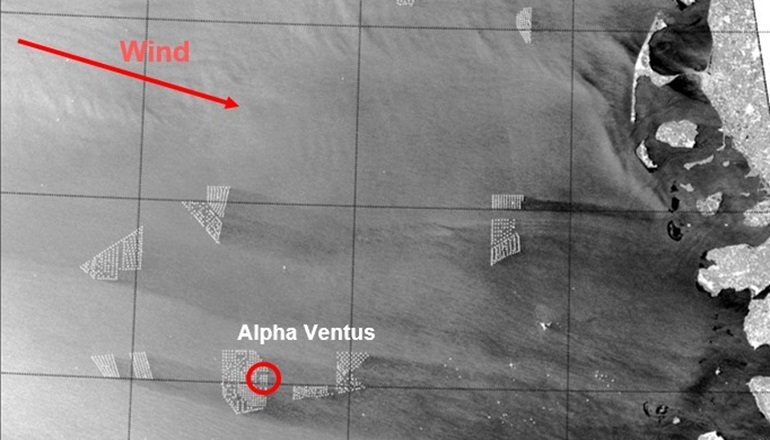
RWE and its academic partners in Germany are investigating how the total energy yield of offshore wind farms can be optimised.
RWE, together with its project partners at ForWind (University of Oldenburg – Institute of Physics), Helmholtz-Zentrum Hereon and Fraunhofer Institute for Wind Energy Systems IWES, has begun the C²-Wakes (Controlled Cluster Wakes) research project.
The aim is to use an extensive offshore wind measurement campaign and modelling methods to determine if and how large-scale wake effects and the global blockage effect can be reduced in the future.
The project is being funded by the German Federal Ministry for Economic Affairs and Climate Action (BMWK) with a total of around €2.86m.
As the areas available for offshore wind farm development in the German Bight are limited, efficient use of this space is required to maximise the benefit of offshore wind.
Offshore wind farms are often installed in groups known as clusters.
Precise determination of the wind potential helps to optimise the energy yield from the areas. In C²-Wakes, scientists are investigating how the planning and operation of large offshore wind farms and clusters can be improved and rendered more efficient.
The turbines in large clusters can influence each other, with wakes with lower wind speeds and higher turbulence developing behind the turbines.
Improved modelling and measurement of the wakes allows optimised site selection and resource planning for future offshore wind farms.
The project team is collecting data via a comprehensive scanning lidar measurement campaign in RWE’s Amrumbank West offshore wind farm close to the German island of Heligoland.
The devices installed on the turbine nacelles measure the flow fields downstream of the machines.
Using the acquired data, the scientists can analyse how the wind speeds evolve within the wind farm as well as how internal and large-scale wake effects behind the wind farm change if the control strategy is adapted, for example by testing wake steering.
“In the C²-Wakes project, we can draw on our findings from the earlier research project X-Wakes, where we gained a fundamental understanding of the interaction between long-range wake effects, the global blockage effect, and the coasts in the German Bight,” said Fraunhofer IWES project coordinator Martin Dorenkamper.
“These findings help us to investigate whether and how large-scale wind farm effects can be influenced. Among other things, we are combining assumptions about future wind turbine technologies, wind farm designs, and active wake steering.”
As part of the project, the scientists at the University of Oldenburg, ForWind, are developing and evaluating high-resolution simulation methods and lidar measurement scenarios.
The team from Helmholtz-Zentrum Hereon is analysing satellite data and further developing methods for wind field reconstruction, which, in turn, should provide an answer to the question of how different wind turbine technologies, wind farm structures, and wind farm layouts impact wake effects.
Offshore wind farms off the British coast will be analysed as well.
RWE Offshore Wind chief operating officer Thomas Michel said: “We are pressing ahead with the expansion of offshore wind energy worldwide.
“At the same time, we also intend to further accelerate the development and demonstration of innovative solutions.
“With the research results of the C²-Wakes project, we have the opportunity to make offshore wind energy even more cost-effective and efficient.”