


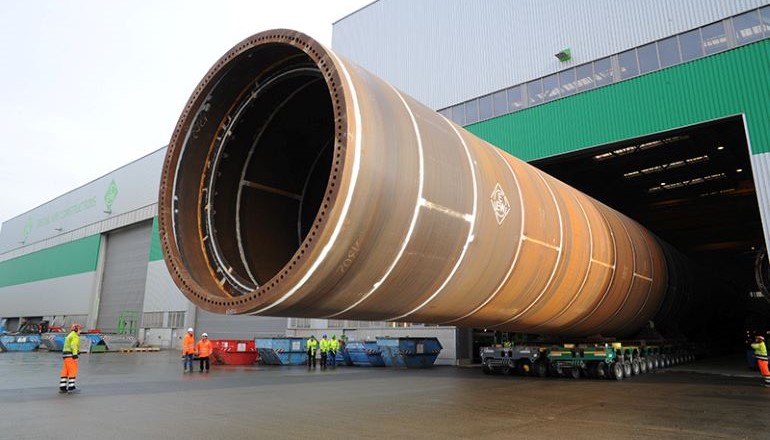
Germany’s Federal Institute for Materials Research and Testing (BAM) has launched a three-year project to optimise monopile foundations for offshore wind turbines.
The OptiMP initiative, run with partners from industry and research, will target reduced steel consumption and longer service life for the large cylindrical foundations that anchor turbines at sea.
Monopiles can measure more than 100 metres in length and 15 metres in diameter, with each unit requiring over 2000 tonnes of steel and energy-intensive welding.
Current designs typically last no more than 30 years, constrained by corrosion and mechanical stress.
Project manager Marc Thiele of BAM said: “Through targeted improvements at all process stages, we expect to achieve steel savings of up to ten percent and extend service life by up to 30 percent.”
Work will focus on optimising critical areas such as weld seams and free edges to improve fatigue strength and corrosion resistance.
New post-treatment techniques, non-destructive crack detection and realistic load simulations will also be developed.
“In close cooperation with partners from industry and certification, we aim to quickly incorporate the project results into standardisation and thus accelerate their transfer into industrial practice,” added Thiele.
Partners in the consortium include the Fraunhofer Institute for Large Structures in Production Engineering, Leibniz University Hannover, JBO Engineering Group, Grillo Zinc Metals and Vattenfall Europe Windkraft.
Supporting organisations include EEW Special Pipe Constructions, Siemens Gamesa, EnBW, ZEISS/GOM, Skyborn Renewables and DNV.
The OptiMP project is funded by the Federal Ministry for Economic Affairs and Energy under Germany’s 8th Energy Research Programme.