


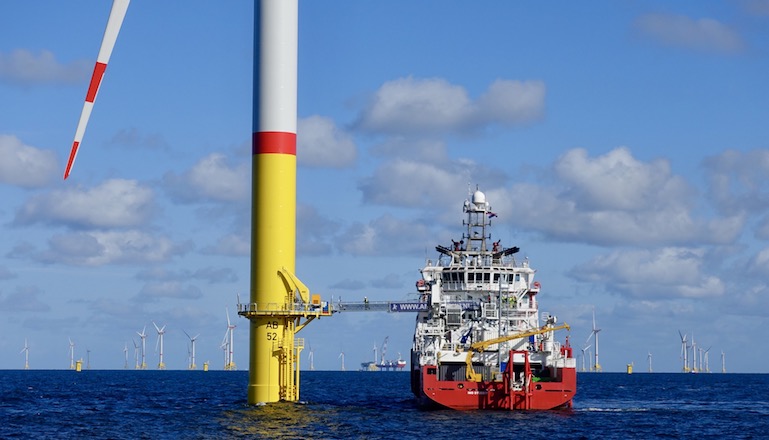
No new offshore wind turbines will be installed in Germany this year, for the first time in 10 years, according to German industry groups.
The expansion gap is not an expression of a lack of interest from investors or a lack of strength from industry, but a consequence of political decisions, the effects of which are now becoming visible for the offshore wind industry in Germany, the groups said.
They added that this can only be counteracted by raising the expansion targets for offshore wind energy, retaining skilled workers and specifying the expansion plans for green hydrogen.
BWE, BWO, Offshore Wind Energy Foundation, VDMA Power Systems and WAB said federal government’s new goal of achieving climate neutrality by 2045 should be underpinned by concrete expansion goals for offshore wind and green hydrogen, followed by a goal by 2050.
Goals for offshore wind for 2030 and 2040 must be adjusted, they said.
Goals should be in line with demand forecasts for green electricity and green hydrogen and the EU’s goal of expanding offshore wind energy to 300GW by 2050.
This enables planning that can be further developed through Europe-wide and international cooperation, they said.
The groups added that the foundations for green hydrogen should also be laid now.
Expansion targets formulated last year for offshore wind in connection with green hydrogen by 2040, require additional areas to be defined in the North and Baltic Seas as soon as possible, they said.
Competing interests in the interests of shipping, the navy and nature conservation must be resolved in the interests of climate protection in order to ensure that the defined goals are achieved.
“Economic production of green hydrogen is not possible on the areas previously intended for the production of green hydrogen at sea – and so far not connected by cable or pipeline – in order to make a high contribution to the hydrogen target of 5GW by 2030 in Germany,” the groups added.
“It is clear to us that capacities of well over 50GW offshore wind are necessary and also feasible in the German North Sea and Baltic Sea,” they said.
The groups added that in order to implement the National Hydrogen Strategy, politicians must also create a market-based basis for green hydrogen and also demand this at the European level.
The framework for the EEG surcharge exemption for green electricity for hydrogen generation is a good approach, which must be followed by additional steps.
These include a binding target for the generation of green hydrogen from offshore wind energy and reliable allocation mechanisms.
They said that in order to achieve the set goal of ramping up the market for hydrogen, it is urgently necessary to combine hydrogen production with the expansion of wind energy capacities at sea.