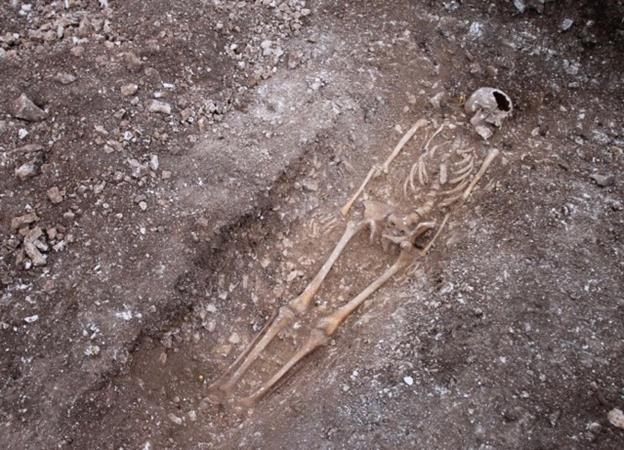
A human skeleton dating from the 11th century was discovered during onshore works for the 400MW Rampion offshore wind farm is located off the south coast of England.
The remains of a 25 to 35-year-old adult male were found by archaeologists from Archaeology South East working on behalf of the Rampion project back in 2015 during survey work for the onshore cable.
The grave was discovered in chalk bedrock on the south-western side of Truleigh Hill, north of Shoreham-by-Sea, project developer Eon said.
Archaeologists believe the man’s remains show he was executed some time between 1010 and 1025 AD.
Archaeology South East project manager Jim Stevenson said: “Specialist osteological assessment and radiocarbon dating has revealed that the skeleton is most likely to be an execution burial of the later Anglo Saxon period of around 1010-1025 AD.
“Most significantly two cut marks made by a sharp blade or knife were found at the mid length of the neck, which would have proved fatal for the individual.”
Rampion development and stakeholder manager Chris Tomlinson said: “We have been very intrigued by this unexpected Saxon discovery and it has been fascinating to learn so much from the radiocarbon dating research and analysis about this person and how they met their end.”
Commissioning of Rampion’s 116 MHI Vestas V112 3.45MW turbines was completed in April.
Eon, Canadian energy infrastructure company Enbridge and a consortium comprising the Green Investment Group, Macquarie European Infrastructure Fund 5 and the Universities Superannuation Scheme are investors in the wind farm.
Image: Eon
Grave discovery at Rampion
 By EBS