


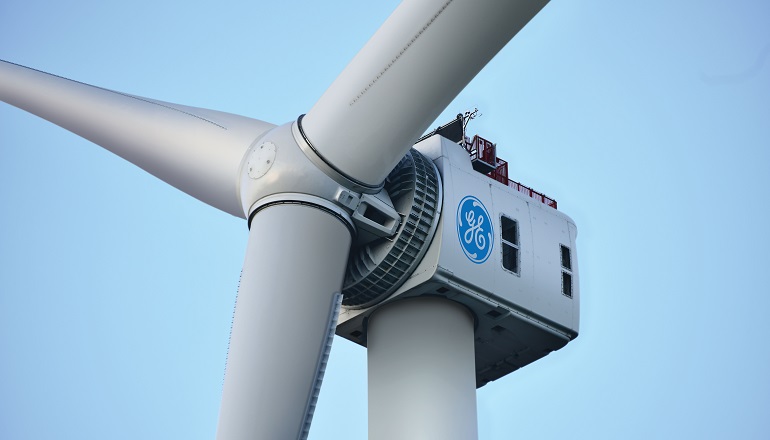
GE Renewable Energy’s 12MW Haliade-X offshore wind turbine has started turning and produced it first kilowatt hour of clean power.
The turbine, installed in Rotterdam-Maasvlakte, in the Netherlands will now progress to the testing phase, said the manufacturer.
During testing different types of measurements will be carried out to obtain a type certificate for the Haliade-X in 2020.
GE Renewable Energy offshore wind chief executive John Lavelle said, “This first kWh is a critical achievement for our whole team, bringing to fruition our vision and all the hard work put in place.
“Innovation is part of GE’s DNA, and having successfully powered the world’s first 12MW wind turbine, this illustrates it perfectly.
“There are more than 500 GE women and men behind this great success, who have been working for a year and a half to make this possible, and I’m taking this opportunity to thank all our partners and suppliers for their commitment and support.”
The Haliade-X has already been selected as the preferred wind turbine for the 120MW Skipjack and 1100MW Ocean Wind projects, which Orsted is developing in the US, as well as SSE Renewables’ and Equinor’s 3600MW Dogger Bank offshore wind farm in the UK.
Serial production of the Haliade-X will start at the second half of 2021.
GE acknowledged the successful completion of the project was due in part to support and commitment of several entities, including the City of Rotterdam, The Port of Rotterdam, Dutch research and development organisation TNO-ECN, TKI Wind op ZEE, Netherlands enterprise agency RVO, the French Investment Secretary and the French Agency for Environmental and Energy Management (ADEME).
In addition, a second Haliade-X 12MW nacelle is currently being assembled in Saint-Nazaire and will soon be shipped to ORE Catapult’s testing site in the UK, where it will undergo a programme that will replicate real-world operational conditions to reduce the time required to validate performance and reliability.
In August, a 107-metre-long blade was also shipped to ORE Catapult’s site to undergo a full range of static- and fatigue-testing procedures to demonstrate the blade’s ability to withstand peak wind conditions and to simulate the blade’s readiness for years of operation at sea.
A second 107-metre blade is about to undergo testing at Massachusetts Clean Energy Center’s wind turbine testing facility.