


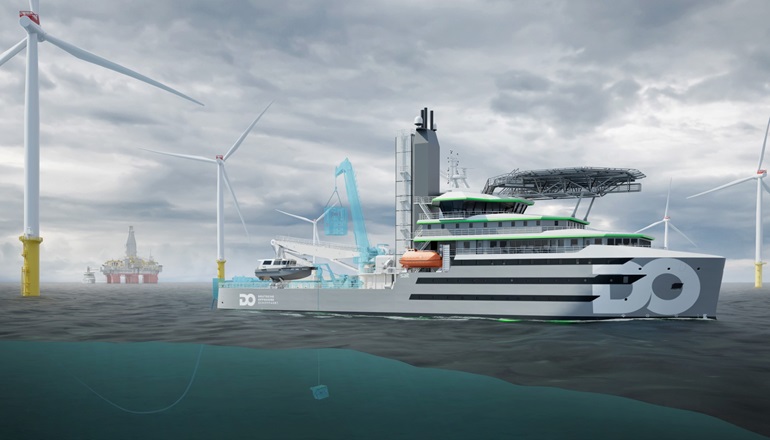
Schoeller Holdings and Deutsche Offshore Schifffahrt have ordered four construction commissioning service operation vessels (C-CSOVs).
The joint venture, launched a year ago, has ordered the ships (picture of vessel’s design) from CSSC Huangpu Wenchong Shipbuilding, part of China State Shipbuilding Group, for delivery beginning in early 2027.
The vessel type will be able accommodate up to 100 technicians.
The C-CSOVs will offer maximum operational flexibility, for deployment in offshore wind as well as other offshore energy sectors.
The 96.25-metre-long and 20-metre-wide ships will be capable of performing work above and below water for wind farm developers and operators, turbine manufacturers, grid operators and companies in the oil and gas sector.
Technical management will be provided by Columbia Shipmanagement, which is part of Schoeller Holdings.
“The energy market is desperate for new players and more ships,” said Deutsche Offshore Schifffahrt managing partner Philipp Maracke.
“We will charter out the C-CSOVs worldwide, both on the spot market and for long-term contracts of up to 15 years.”
Maracke founded the company together with Johannes Wolters, who acts also as managing partner.
The C-CSOV design has an enlarged and fully modular working deck, providing over 850 square metres of unobstructed multipurpose space.
When used in conjunction with a 50-tonne AHC crane featuring integrated 3D motion compensation, the special-purpose vessel will be able to perform not only conventional offshore wind tasks but also cable repairs, IMR and light construction work both above and below water.
The fully integrated offshore gangway system will provide access to platforms between 12 and 30 metres above the waterline.
A spacious lift will allow technicians and the necessary material to be transported to the offshore facilities quickly and without steps.
A 12.4-tonne helicopter deck will satisfy the offshore industry’s requirements for these kinds of special-purpose vessels. The ship has also been designed for the use of remotely operated vehicles (ROVs).
Optimised hydrodynamics in conjunction with an energy-efficient configuration of the propulsion and energy system will reduce fuel consumption, thus emissions, significantly.
Each vessel includes large, well-equipped living and leisure facilities, such as a 165 square metre gym, entertainment rooms, spacious lounges and a weather-protected outdoor recreation balcony.
Wolters said: “By combining a modified layout with modularity, we have created a vessel that is attractive for a wide range of customers without having to make compromises in the offshore wind market.”
The ship blueprint was jointly developed by Deutsche Offshore Schifffahrt and the Norwegian company Salt Ship Design.