


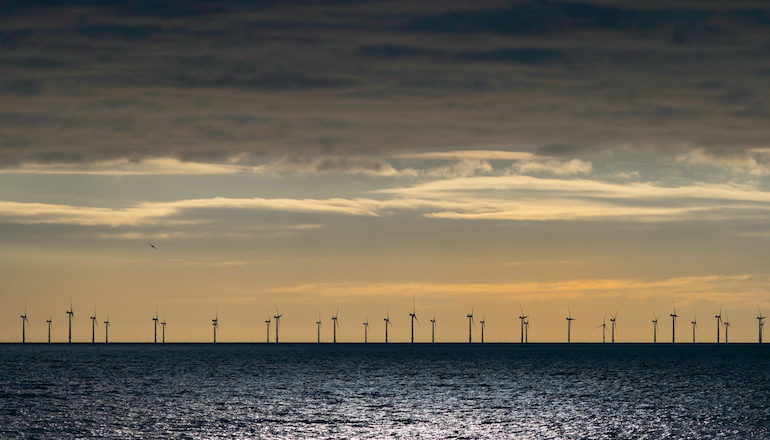
Underlying data points within the offshore wind sector are positive, and the long-term outlook for growth of the sector remains strong despite the inflationary challenges of recent years, according to new statistics.
Ahead of WindEnergy Hamburg 2024, Clarksons Research have released a range of data points profiling the sector.
Today, 76GW of offshore wind capacity is active globally, involving around 13,800 turbines and 327 wind farms, a 13% year-on-year increase.
The leading country by capacity is China, with 37GW installed over 139 wind farms with around 6,500 turbines, followed by the UK (15GW, 48 farms, 2,800 turbines) and Germany (8GW, 29 farms, 1,600 turbines).
There are now 20 countries with active offshore wind capacity, and Clarkson Research expects this to increase to 32 by 2035.
Steve Gordon, managing director of Clarksons Research, said: “We are projecting growth globally of 17% (+11.8 GW) in 2024 and 35% (+29 GW) in 2025.
“We forecast active offshore wind capacity will reach 450GW and over 40,000 turbines globally by 2035, supported by underlying ‘energy transition’ and energy security trends.
“Offshore wind energy is projected to account for between 7% and 9% of the global energy mix by 2050, up from just 0.4% today.
“Investment in new offshore wind projects has remained positive, with US$28bn having been committed globally in the year to date following a near-record $58bn last year (including a record $33bn in Europe).”
Clarkson Research also found that European wind vessel markets remained strong through the summer of 2024.
Dayrates for WTIVs and “W2W” units were up by 25%-35% year on year across the peak season, and the outlook for both markets appears positive.
It also estimates that US $4.6bn has been committed for new build vessels (including US$1.5bn for C/SOVs and US$940m for cable layers) in 2023 and US$2.4bn in 2024 (including US$980m for C/SOVs and US$420m for cable layers), including orders for dual fuel methanol and hydrogen vessels.