


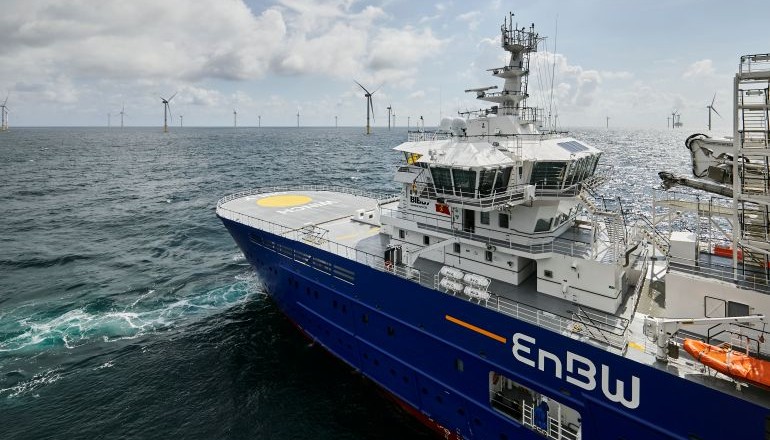
Construction work has begun on one of Germany’s largest offshore wind projects, in the North Sea.
The 960MW He Dreiht offshore wind farm, worth an investment of €2.4bn, is being developed by EnBW.
He Dreiht is being built roughly 85km north-west of Borkum and about 110km west of Helgoland.
More than 500 employees will work on this large construction site in the middle of the sea at peak times.
Over 60 ships are involved in the construction of the wind farm.
The Thialf, one of the world’s largest floating cranes, will install the first foundations in the seabed in the next few days. A monopile – a 70-metre-long steel foundation, 9.2 metres in diameter and weighing around 1350 metric tons – will be used, upon which a transition piece will be placed, the connecting element between the tower of the turbine and the base.
The monopiles and transition pieces had previously been loaded onto floating platforms in Eemshaven in the Netherlands and towed to the construction site by tugboats.
Work on installing all of the foundations will continue into the summer.
The 15W Vestas turbines and cables are being manufactured at the same time.
These will be installed and laid in early 2025.
He Dreiht was secured in the first offshore auction held in Germany in 2017 and is scheduled to go into operation at the end of 2025.
EnBW will be responsible for the technical and commercial management.
Servicing and maintenance work will be carried out from its service base in Emden.
TenneT will connect the wind farm to the grid using an offshore converter station and two HVDC export cables.
The cables will be laid over a distance of 120km underwater and 110km on land.
From the landfall point near Hilgenriedesiel, the electricity will be transmitted by buried cable to the future Garrel/Ost converter station in the Cloppenburg area.
A partner consortium made up of Allianz Capital Partners, AIP and Norges Bank Investment Management owns 49.9% of the shares in He Dreiht.
EnBW chief executive Georg Stamatelopoulos said: “EnBW will play its part in further accelerating the energy transition in Germany, which is why it wants to invest a total of €40bn in the energy transition by 2030 – the lion’s share of it in Germany.”