Germany’s new renewable energy law, approved by its parliament this week, is not as ambitious as other EU member states and lacks stability in volumes for offshore wind, according to WindEurope.
The law sets an offshore cap, which will apply from 2021–2030, that will vary from year to year to ensure that Germany reaches its 15GW wind energy target in the next 15 years.
It will also replace feed-in tariffs with competitive auctions.
Under the plan, 500MW of offshore wind will be supported in 2021 and 2022, which is less than the 730MW annual target initially proposed.
WindEurope chief executive officer Giles Dickson said: “The build out rate [for offshore wind] after 2020 will be uneven as the auctions vary in size from year to year.
“The volumes are also less ambitious than other member states such as the UK, which has committed to 1GW a year to 2030 and the Netherlands, which will tender 1.4GW this year and then a further 700MW each year to 2020.
“The shift from feed-in tariffs to tenders is a trend we are seeing across Europe. Germany’s move was to be expected as member states bring their support schemes into line with the European Commission’s state aid guidelines.”
Onshore wind auctions are capped at 2.8GW and are expected to increase after 2020 to 2.9GW a year.
The reforms are expected to come into effect in January 2017.
The annual caps also include repowering – the process of replacing old turbines with new, higher capacity models.
Dickson said: “For onshore wind, the reforms set out clear volumes for wind energy deployment toward 2020 and beyond.
“This gives the industry a degree of certainty on investments and the opportunity to plan into the future.”
He added that Germany’s lack of transmission infrastructure is a big challenge.
“Lawmakers must find a way to ensure that power generated in northern Germany from renewables such as onshore and offshore wind can be transferred to the power-hungry South,” he said.
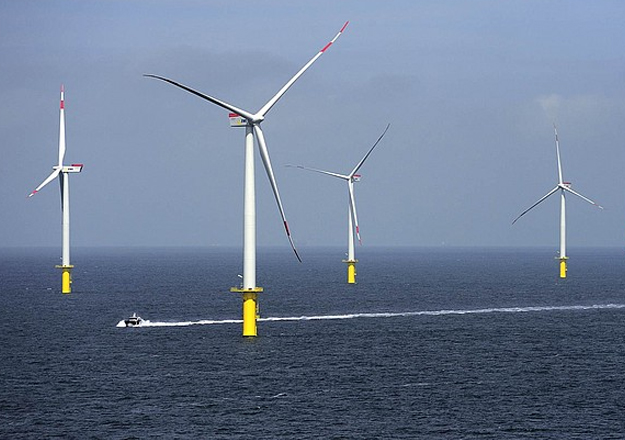
Image: Riffgat offshore wind farm (EWE)
Industry questions German roadmap
New energy law lacks ambition and is ‘uneven' says WindEurope
 By EBS