


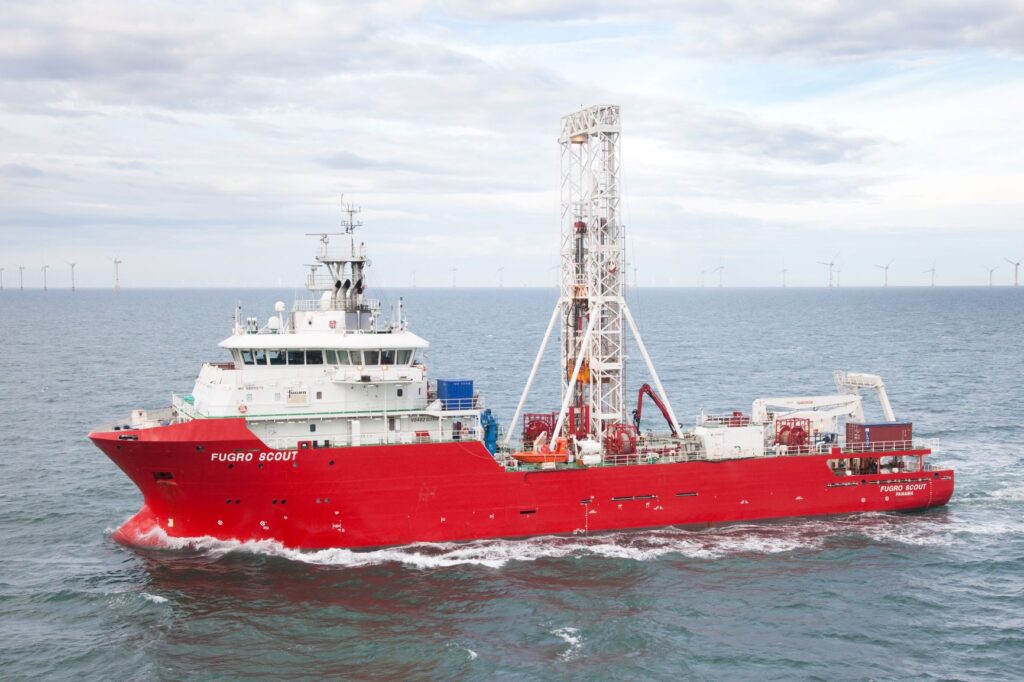
Four vessels are about to start the latest tranche of survey work at Innogy’s 1400MW Sofia offshore wind farm off the north east coast of England.
Two vessels – the multi-purpose Despina and survey unit Fugro Scout (pictured) – will complete the site investigation work on the 593 square km array area located on Dogger Bank in the North Sea.
They will carry out the geotechnical surveys on the wind farm site following on from probes undertaken earlier this year.
The information gathered will be used to fine tune the array design, as well as determine the installation of the foundations, array cables and the offshore converter platform, Innogy said.
The other two ships – Fugro Seeker and Fugro Mercator – will work close to shore to carry out geophysical surveys along the nearshore export cable corridor just off the coast of Redcar, Teesside.
They will collect data that will inform both the design of the export cable and the installation methodology, building on work already done by Fugro Pioneer and Despina.
All four vessels are expected to complete the work by July, weather permitting, with a local guard vessel supporting the activity throughout.
The work is the latest in a six-month site investigation campaign.
The final site investigation work is due to start in July with a jack-up barge set to carry out nearshore borehole surveys along the export cable route at the landfall between Redcar and Marske-by-the-Sea.
Sofia senior project manager Damien Fensome said: “The survey data will be analysed to enable our consent and engineering teams to fully understand the complex geological and geotechnical conditions of the seafloor and subsurface along the cable corridor and on the wind farm site itself.
“The health of the survey teams is our priority during the current Covid-19 situation so we have worked closely with our service provider Fugro to ensure compliance with government guidelines and corporate policy in relation to the health, safety and welfare of employees.
“With these measures in place it means we are able to continue our survey operations in an effort to maintain the construction schedule for this significant project, which represents a £3bn investment into renewable energy infrastructure and a welcome boost for the UK economy.”
Onshore construction is expected to start in early 2021 and offshore work in 2023.