


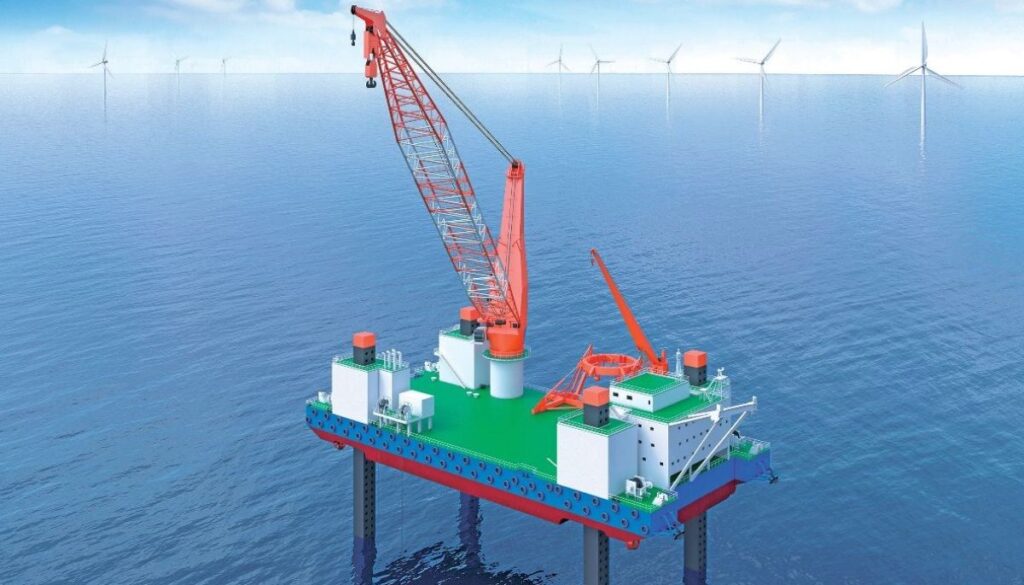
ClassNK has issued an approval in principle (AiP) for the conversion plan of the medium-sized self-elevating platform (SEP) vessel (pictured) for the installation of large wind turbine on a semi-sub floater in port.
The project has jointly developed by TOA Corporation (TOA), Nihon Shipyard (NSY), and Japan Marine United Corporation (JMU). This project involves a semi-sub floater developed by JMU, and a large turbine to be installed by converted SEP vessel.
As a solution to the current lack of port facilities for installing a large wind turbine on a foundation at ports in Japan, TOA, NSY and JMU have been jointly researching and developing a method to convert a medium-sized SEP vessel to be used as a jacked-up tall crane in a port.
The three-party’s joint R&D is based on the SEP vessel (equipped with a 1,250-ton crane) under the construction at JMU shipyard and to be co-owned by two companies including TOA corporation after her delivery.
The converted SEP will enable the installation of large wind turbines even at ports without adequate facilities and is expected to promote the expansion of floating offshore wind power generation by providing a wider range of base port options. ClassNK carried out a review of the jointly developed conversion plan in line with Part O of the Rules for the Survey and Construction of Steel Ships and issued the AiP on verifying conformity to the prescribed requirements. ClassNK will continue to support advanced initiatives aimed at the broader adoption of offshore wind power generation as the certification body and contribute to the decarbonization of society.