


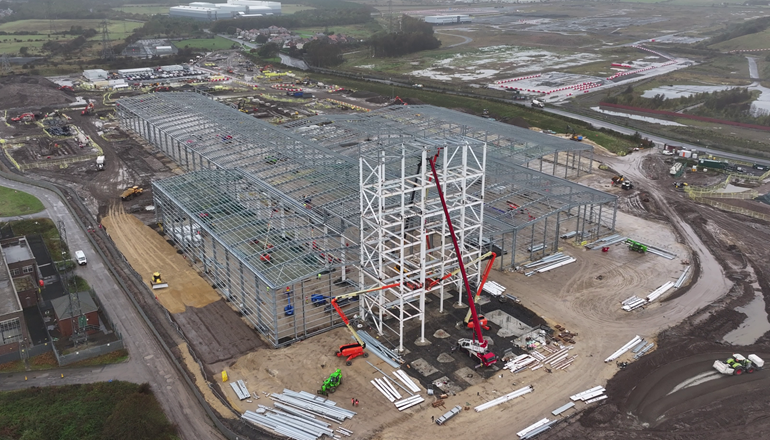
JDR Cable Systems has achieved several milestones in the construction of its new £130m factory in Northumberland, north-east England.
The subsea cable factory in Cambois, near Blyth, Northumberland, which is supported by the UK government, now has over 150 building pad foundations constructed while a substantial portion of the steel frame for the main hall has been erected.
All piling for the foundations of the Vertical Lay-up Machine and Continuous Catenary Vulcanisation (CCV) Towers have now been completed.
Once operational, the CCV line will establish the site as the only facility in the UK capable of full start-to-finish manufacturing of high-voltage subsea cables.
These wires are required for offshore wind farms and to enable the subsea energy infrastructure which is essential for the growing global renewable energy market.
The towers are supported by a total of 250 piles drilled to a depth of 24 metres below ground level to reach bedrock and provide the essential support for the advanced machinery housed within them.
A crucial application of the facility will be the production of high and extra-high voltage cables at 132kV and above.
These will enable the operation of larger turbines offshore, allowing the connection of more power back to shore.
With the facility foundation work nearing completion and over 1700 tonnes of concrete foundations now having been poured, the project is on course to meet the significant increase in demand expected for high-voltage cables in the middle of the decade.
Machinery deliveries for the facility are also progressing, with complex, high-quality European manufactured machines already completed and ready for installation, which will take place once the building is sealed, and floor slab completed in coming months.
Chief strategy and compliance officer at JDR Cable Systems James Young said: “We are proud to contribute to the growth of the renewable energy sector and the UK’s position in offshore wind manufacturing.
“Constructing this first-in-class facility in the UK enhances our ability to produce high-quality, high-voltage subsea cables, that we know will be essential in meeting the demands of not only the offshore renewable energy market, but also the wider needs of the energy sector as we seek to decarbonise our energy system and achieve net-zero emissions by 2050.”