


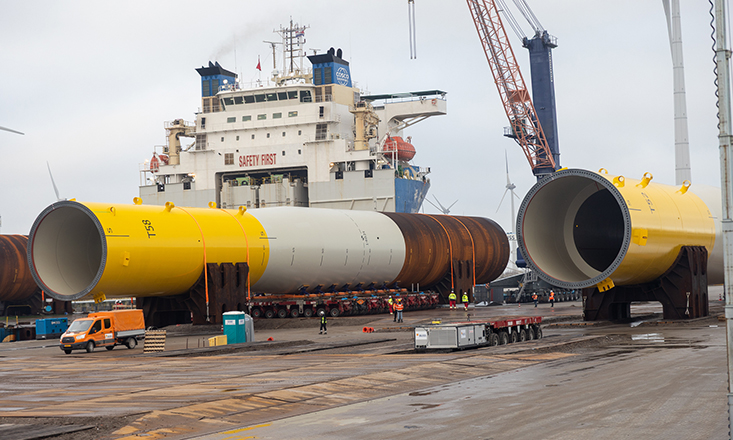
Mammoet has marshalled 116 XL monopile foundations for the Nordseecluster A and Thor offshore wind farms.
The company said a more efficient load-in phase resulted in fewer transcontinental sea voyages.
In 2023, it was selected by Buss Ports to marshall foundations for Nordseecluster A in Germany and Thor in Denmark.
Nordseecluster (A & B) and Thor are joint offshore wind projects of RWE (51%) and Norges Bank Investment Management (49%). Combined, they will achieve a total planned capacity of up to 2.6GW.
Mammoet’s scope was to manage the phased load-in, temporary storage and load-out of 116 XL monopile foundations for both wind farms at Buss Terminal Eemshaven in the Netherlands.
With different specifications of monopiles being shipped to the port in different numbers, the load-ins had to be planned so that marshalling equipment was configured in advance and space at the port could be managed effectively.
Adding further complexity was the limited ground bearing capacity of the quay, an unusual shipping configuration and the fast-changing tides.
Mammoet said it not only marshalled the monopiles for both projects safely and efficiently, but was also instrumental in supporting Buss to reduce the total number of load-ins, saving on several 60-day global sea voyages.
Preliminary engineering work began in September 2023, with Mammoet carrying out a feasibility check using its XXL monopile transport system as a basis.
Buss has developed its own saddle system for large monopiles and wanted to put it to work on this project with Mammoet’s self-propelled modular transporters (SPMTs). Engineers at Mammoet worked with Buss to ensure its saddle system was compatible.
The 1500-tonne monopiles for Nordseecluster A were 85 metres in length on average, while the 1500t foundations for Thor stretched approximately 100 metres.
The XL monopiles were offloaded onto the quay using a RoRo linkspan ramp and transported using 80 axle lines of SPMT fitted with the Buss saddles.
Monopiles are normally transported in a longitudinal configuration. However, to deliver more units per voyage they were loaded in a transverse orientation and protruded slightly over the side of the vessel.
To support this, Mammoet needed to unload these structures ‘sideways’. This methodology also allowed the load-out method from China to be reversed.
Due to the low ground-bearing capacity of the quay, an unusually long linkspan ramp was used.
To ensure the tidal constraints were comfortably met, the monopiles were offloaded with their sea grillages still attached, allowing the SPMTs to disembark quicker.
Once the components were on the quayside, the grillages were removed using additional SPMTs. The monopiles were then driven to a temporary storage area and placed on sand bunds.
For the final load-outs, the monopiles were driven back to the quayside and lowered into concrete cradles, ready to be lifted onto the delivery vessel using its on-board crane.
Mammoet said: “By overcoming the tidal constraints and the limited ground-bearing capacity of the quay, it made it possible for up to 10 monopiles to be delivered at a time instead of eight or nine.
“Over the duration of this year-long project, several trips from China were spared as a result. With each voyage taking around 60 days of sailing, the time and cost savings were significant.”