


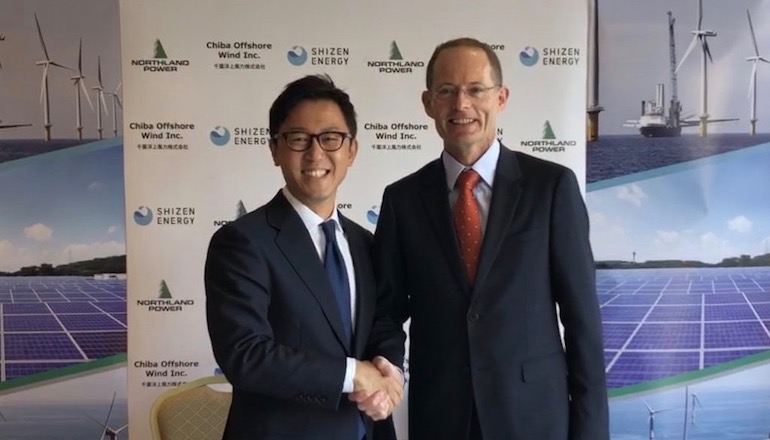
Canadian company Northland Power is setting up a joint venture with local outfit Shizen Energy to work on early stage offshore wind developments off the coast of Chiba prefecture in Japan.
The 50:50 JV called Chiba Offshore Wind will target projects with a combined capacity of approximately 600MW.
Northland president and chief executive Mike Crawley said: “We are excited to partner on this joint venture with Shizen Energy, which marks Northland’s entry into the burgeoning Japanese offshore wind industry.
“With Shizen Energy’s strong track record of developing and constructing renewable projects in Japan, and Northland’s success developing, constructing and operating offshore wind farms globally, we view this agreement as an excellent opportunity to combine the strengths of the two companies to achieve something great.”
Shizen Energy representative director Masaya Hasegawa (pictured, left) said: “Taking action for the blue planet’ is our company’s foremost priority, and we hope to pass the blue planet on to the future generations.
“To achieve this goal, we aim to grow as a company and cooperate with other businesses worldwide to shape our common future.
“We strongly believe that our partnership with Northland will allow us to put that vision into action and bring us a step closer to making a positive impact on the future of our blue planet.”
Shizen Energy has contributed to the development of approximately 1GW of renewable energy in Japan and is expanding its portfolio to include solar, onshore and offshore wind, biomass and hydro power generation.
Northland Power has a global fleet of assets generating in excess of 2.4GW.
It also has a project pipeline of over 1.4GW under construction and at an advanced stage of development.
Northland executive vice president of development David Povall is pictured (right).
The Japanese government issued an updated energy supply plan in July 2018, targeting 10GW of wind capacity – both offshore and onshore – by 2030 as part of its ambition to reach a 22-24% renewable share of electricity generation by 2030, the partners said.