


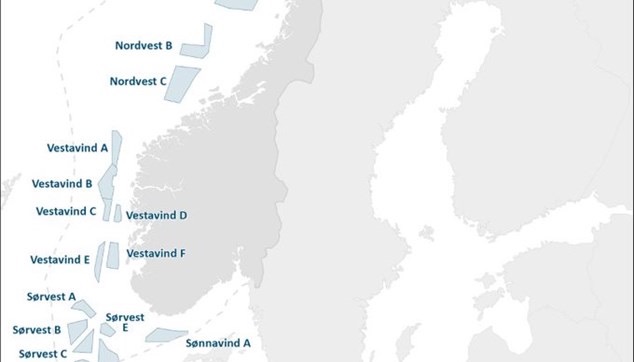
The Norwegian Water Resources and Energy Directorate (NVE) has identified 20 areas for offshore wind, which are recommended to be investigated further.
These are areas that are technically suitable for offshore wind, and where conflicts of interest are relatively low, NVE said.
It now plans to carry out impact assessments will be carried out to further narrow down the areas.
The 20 areas were identified together with several directorates and specialist communities.
They were found to have good wind resources, where conflicts of interest between the environment, fisheries and other industries are relatively low.
These are areas along the entire coast, from Skagerak in the south to the Barents Sea in the north.
These sea areas should now be investigated in more detail to find the areas that are best suited for offshore wind, said watercourses and energy director Kjetil Lund.
The Norwegian government has an ambition to prepare areas for the development of 30GW of offshore wind. Such a development would correspond to almost a doubling of Norwegian power production.
The Ministry of Petroleum and Energy (OED) asked NVE for a recommendation on which sea areas may be relevant for wind power.
The entire directorate group believes that within 19 of the 20 identified areas, it will be possible to develop projects that both take account of land values and that can coexist with other interests.
Lund said: “We don’t have a final decision today on how much offshore wind will be built and where.
“We will need further studies on environmental and business interests, but also on economics, effects on the power system and the need for grids.
“In that process, it is conceivable that some areas will be reduced or eliminated altogether.”
All the identified areas must go through a strategic impact assessment, before any opening and announcement.
In addition to the maps with the 20 areas and professional descriptions, the directorate group has drawn up a proposal for a study programme, which will be sent for consultation.
This sets the framework for further investigations, which will provide a better knowledge base and facilitate the selection of the areas most suitable for the development of offshore wind.