


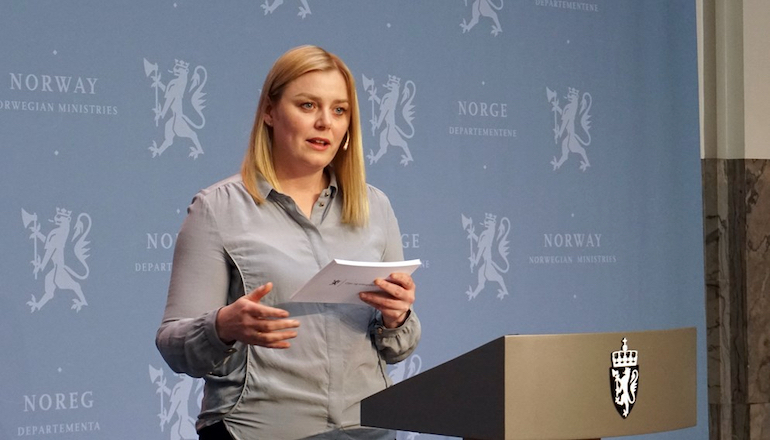
Norway is aiming to announce an auction for the Sorlige Nordsjo 2 offshore wind zone in the first quarter of next year, but the government will adopt a different process to award concessions for the Utsira Nord area.
Minister of Petroleum and Energy Tina Bru (pictured) told the Floating Wind 2021 conference in Norway today that Sorlige Nordsjo 2 represents opportunities for profitable bottom-fixed wind projects in Norwegian waters without state aid.
She said that two to three project areas will be awarded in the zone based on a two-step process.
The first step would be qualification, followed by the auction where the qualified companies/consortias would participate, the minister said.
Bru added that the government has to put a number of elements in place before the process can start.
“We will have to assess legal and other effects of hybrid projects. And we will have to set the detailed terms for the auction,” she said.
Many developers are looking into hybrid projects, combining offshore wind farms and interconnectors, which will have impacts on the country’s power system, electricity flows and prices, Bru said.
The government will do an assessment on various effects and legal aspects of hybrid projects, aiming to clarify the effects and aspects in advance of an award of areas in Sorlige Nordsjo 2.
Bru said that because the challenges are different for the Utsira Nord zone, a different approach will be taken.
She said: “Considering the current cost of floating wind, any large scale project at Utsira Nord will require state aid to be commercially viable,” the minister said.
“With this in mind, we do not think auctions are the right approach for this area.
“With technology maturing rapidly, and costs coming down, it is difficult to predict what level of support a project of two- to five hundred megawatts will need.”
Awards will be made through a licensing process “based on qualitative criteria” for at least three projects of up 500MW.
Bru said the aim is to start this process by the end of the year.
“When projects have matured sufficiently, we will assess the timing and level of support for floating wind projects,” she added.
Norway will also initiate a process to identify new areas for offshore wind production off the country’s coast on top of the two areas already opened for development.
The process will be led by the Norwegian Water Resources and Energy Directorate (NVE), which will also involve impact assessments of the areas,
Bru said the initiative is expected to take about two years to complete, adding that it would “facilitate future activity and provide predictability for the industry”.
She added that to ensure the “neutral and efficient coordination of the offshore grid users and provide clarity for the developers of offshore wind, there is a need for an offshore system operator”.
Therefore, the government would also start working on regulation for the offshore system operation and will designate Statnett as the operator under the Offshore Energy Act for cables and installations not regulated under the Petroleum Act.
“We will also assess and possibly propose necessary legislative changes and more detailed rules for efficient access to, and use, of the offshore grid,” she said.
The government will also set up an offshore wind collaboration forum to enhance dialogue and reduce potential conflicts.
The forum will bring together industry leaders, public authorities, the research community, industrial clusters, users of the ocean space and additional relevant stakeholders.