


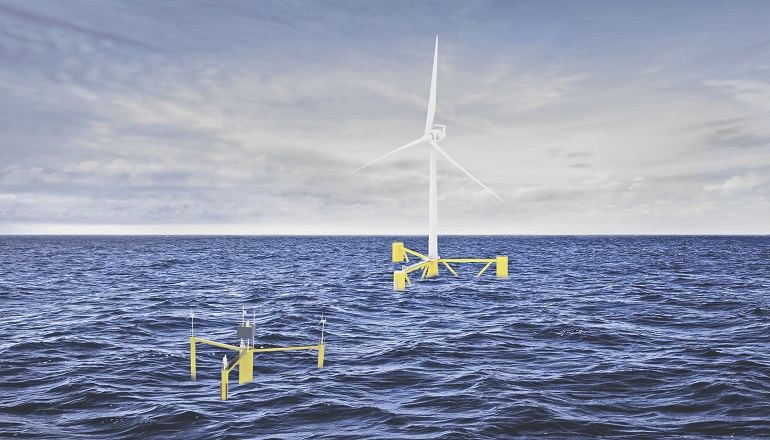
Simply Blue Group, Ørsted and Subsea7 have awarded the pre-FEED foundation design work for their 100MW Salamander floating wind project to Ocergy.
Ocergy has developed OCG-Wind, a “novel and efficient” floating wind turbine foundation, to support large wind turbines (>10MW), designed for development of large-scale wind farms.
It is targeting a levelised cost of energy (LCOE) that can start to drive reductions in floating offshore wind farms to eventually be competitive with fixed offshore wind farms.
OCG-Wind is a semi-submersible platform designed to utilise the industrial performance of the hull fabrication and assembly through the maximisation of the local supply chain.
The hull is made of three outside circular columns connected mechanically with trusses to a central column that supports the wind turbine.
Last year, Salamander signed a memorandum of understanding (MoU) with Ocergy to evaluate its foundation design for the development in northeast Scotland.
A feasibility study considered all aspects of the design, technical performance, fabrication, assembly, operations and installation of the OCG-Wind for Salamander.
It also reviewed the compatibility of the OCG-Wind platform to the site, inclusive of performance, and supply chain and local content management, as well as identified schedule risks and overall project costs. This feasibility study will now progress to pre-FEED phase.
“From inception, the foundation manufacturing and assembly was a crucial element for us in delivering higher local content,” said Huw Bell, Salamander project director.
“We’re focusing on the capabilities of the Scottish supply chain, which is helping us in deciding which technologies to advance. Ocergy’s OCG-Wind technology meets our requirements.”
Bell said they aim to provide access to double the number of Scottish port facilities over some traditional floating concepts due to lower draft requirements.
“We also expect a scalable fabrication and assembly process, suitable for commercial scale deployment as well as decreasing fabricated steel mass by around a third, which will reduce the cost of energy whilst also providing potential for local fabrication,” Bell added.
Salamander, located 35km off Peterhead, is designed to provide the Scottish supply chain with an early capacity development opportunity, enabling it to play a much greater role in subsequent large-scale floating offshore wind buildout.
The project is intended to be progressed through the innovation track of Crown Estate Scotland’s Innovation and Targeted Oil and Gas (INTOG) leasing round.
The INTOG round will grant seabed leases through an auction process, which will be split into two pots – one for smaller scale innovation projects of less than 100MW and one for larger projects linked to oil and gas infrastructure.