


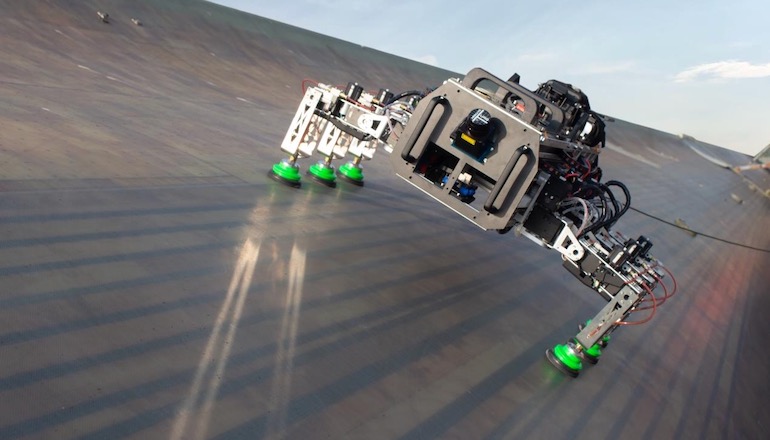
The Offshore Renewable Energy (ORE) Catapult has simultaneously broken ground at its National Renewable Energy Centre in Blyth, north-east England, on a multimillion-pound offshore wind robotics centre and a state-of-the-art additive manufacturing cell that will be used to research next-generation wind turbine blades.
The £3m (€3.5m) offshore wind robotics centre was funded by the UK government’s Getting Building Fund.
Civil work is being undertaken by Durham-based Halls Construction.
The centre is set to be the first of its kind in the UK dedicated to offshore wind, enabling robotic technology developers to access representative, onshore and offshore test and demonstration environments.
It will also form key R&D infrastructure behind the drive to increase robotic intervention in the safety, cost reduction and efficiency of offshore wind farm operations, a market potentially worth £1.3bn by 2030, ORE Catapult said.
The additive manufacturing cell will consist of a 3D printer and six-axis robot with a 165 kilogram payload.
The new capability will support ORE Catapult research into new offshore wind turbine blade technology, materials and manufacturing techniques, including the rapid production of prototype blade enhancements such as vortex generators and edge erosion protection systems.
The new capability will build on the Catapult’s collaborative work with industry and academia to boost the UK’s position in next generation turbine blade research and development, it added.
ORE Catapult test facilities director Tony Quinn said: “These investments underline the Catapult’s commitment to supporting the UK’s rapidly growing offshore wind sector from Blyth, remaining at the forefront of technology development and research.
“This is crucial as projects to deploy the largest offshore wind turbines in the world gather pace, and so accelerating UK-led technology and research to market becomes a priority – and that’s a role Catapult will continue to play with its latest research and development assets.”