


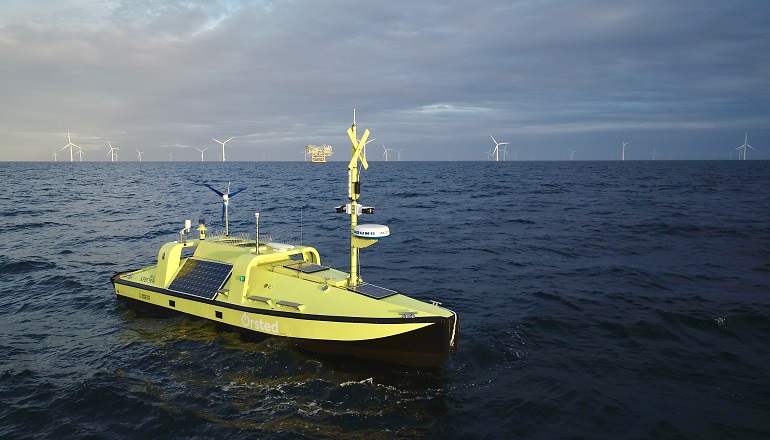
Orsted has designed and developed an uncrewed surface vessel (USV) in the industry for offshore metocean measurement campaigns.
The collected data will help to reduce uncertainties in the expected annual energy production of new offshore wind farms.
Orsted, which has patented the USV concept, sees “enormous potential” in the technology and has initiated serial production based on its prototype.
The prototype, named Hugin USV, is designed for continuous operation in the harshest offshore conditions for a year at a time.
It has a built-in navigation system, which enables the vessel to transit from shore at various degrees of autonomy, and it can be controlled both in line-of-sight or from a beyond-line-of-sight remote control centre.
The USV is designed as a generic sensor platform and can collect large amounts of data on, among other things, wind conditions, the state of the seabed, and biological and ecological measurements, all dependent on the sensor instrumentation chosen for a given operation.
The broad range of measurements collected by the USV is essential for Orsted’s early-phase development activities prior to the construction of new wind farms.
The design, development, construction and testing of the USV was conducted as part of Orsted’s innovation programme in collaboration with selected industry partners.
The prototype is constructed by the Danish shipbuilder Tuco Marine Group and its control system is delivered by the innovative Norwegian company Maritime Robotics.
Working with small and innovative companies and combining their specialist expertise in vessel construction and autonomous control systems, with Orsted’s knowledge of offshore measurement operations, has contributed a fast time-to-market USV prototype.