


The consortium behind ScotWind project Ossian floating offshore wind farm has awarded the contract for geotechnical investigations to Fugro and Ocean Infinity.
The Ossian project is being delivered by a partnership of SSE Renewables, Japanese conglomerate Marubeni Corporation and Copenhagen Infrastructure Partners (CIP).
Set to be located across 858 square kilometres of seabed in waters off the east coast of Scotland, the project could power up to six million homes and offset up to 7.5m tonnes of carbon dioxide emissions each year.
Fugro will focus on downhole geotechnical sampling and in situ cone penetration testing, while Ocean Infinity will concentrate on the seabed scope which will include shallow vibro-cores and deep push seabed cone penetration tests.
SSE Renewables offshore geotechnical technical authority John Davidson said: “This is a major step forward in the exploratory work needed to make the Ossian Wind Farm a reality.
“After a competitive tendering process, it was clear that Fugro and Ocean Infinity have the skills, equipment, knowledge and expertise to embark on a survey of this scale.
“The Ossian team look forward to working with both companies and to realising the geotechnical investigation results which will be integral to the progression of what would be a world-leading floating wind project.”
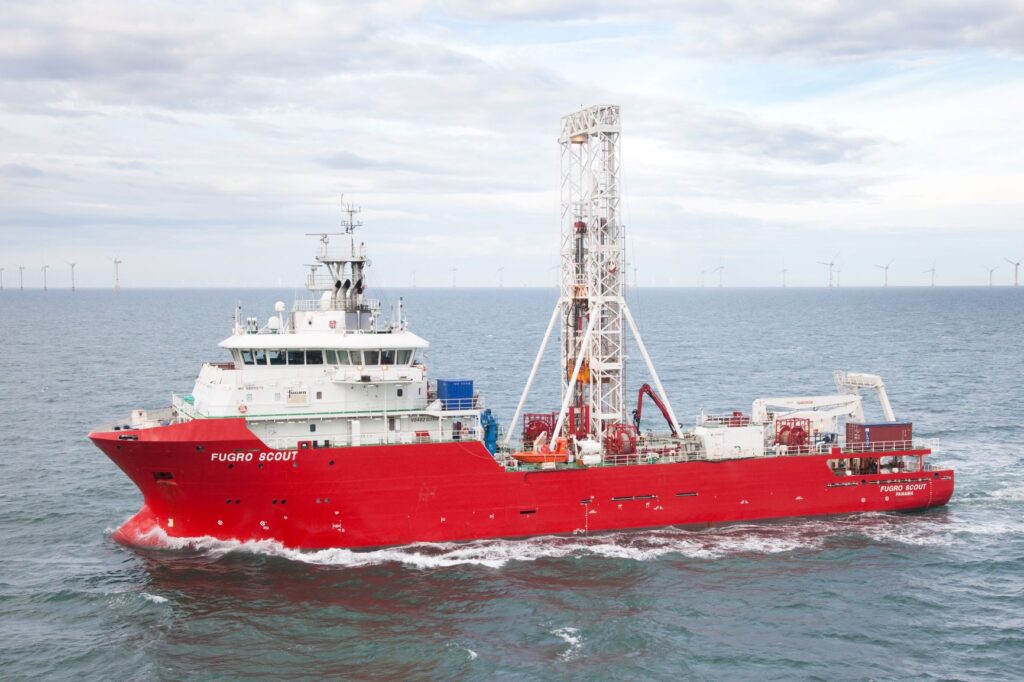
Fugro plans to use its purpose-built geotechnical drilling vessel, the Fugro Scout (pictured).
The ship is equipped with ultra-deepwater drilling technology and state-of-the-art onboard systems which enable the vessel to safely carry out complex marine geotechnical operations.
Meanwhile, Ocean Infinity plans to use its vessel Stril Explorer, which is a multi-purpose support ship with state-of-the-art seabed geotechnical equipment onboard.
Both surveys will commence this spring.
Ocean Infinity expects to have completed its work by the end of May while Fugro expects its downhole scope to be completed at the start of July.
The surveys will significantly improve the seabed understanding across the project site by ground-truthing the already acquired geophysical information.
This will subsequently enable design development activities to progress such as anchor in-place and installation design.