


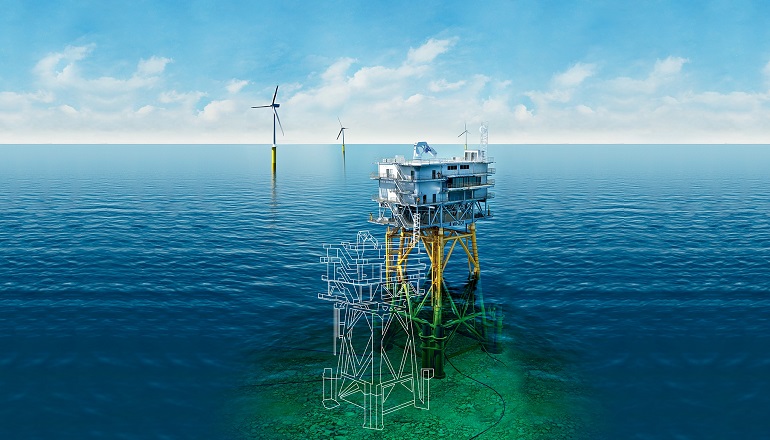
A pilot test of Ramboll’s digital twin software technology shows it could potentially extend the lifetime of offshore wind structures.
The technology has been deployed at the Wikinger offshore wind farm as part of the ROMEO project, an initiative supported by the EU research programme Horizon 2020.
The pilot-test of Ramboll’s True Digital Twin technology is based on a measurement campaign using structural health monitoring (SHM) solutions, which revealed a “significant potential” for lifetime extension for the offshore substation and offshore wind turbine foundations, said Ramboll.
Ramboll wind asset management lead consultant Ursula Smolka said: “Our goal with this project is to demonstrate the feasibility and impact of data-driven O&M strategies by having the True Digital Twin continuously deliver instantaneous insights on the physics of the assets that are being monitored.
“The results from this pilot-test are stunning, revealing significant potential for lifetime extension and cost reductions in operating and maintaining offshore wind structures.”
The results of the pilot-test have been summarised in two reports which Ramboll has delivered to its ROMEO project partners.
Ramboll stated: “The full power of a True Digital Twin lies within the continuous monitoring of the factors that can affect the structural integrity of a wind turbine over its entire lifetime.
“The monitoring process can be done at all possible locations using SHM solutions, cloud computing and advanced mathematical calculations.”
Ramboll’s technology can detect structural integrity issues like failure of jacket braces, excessive scour or corrosion.
Extensive simulation studies showed that monitoring modal properties like natural frequencies and mode shapes not only can detect anomalies but can also identify the type of anomaly if combined with a design model database, the company said.
“The concept of the True Digital Twin makes detailed design models available for predicted lifecycle management and provides the framework to incorporate measurement findings of a specific turbine into the simulation world,” Smolka added.