


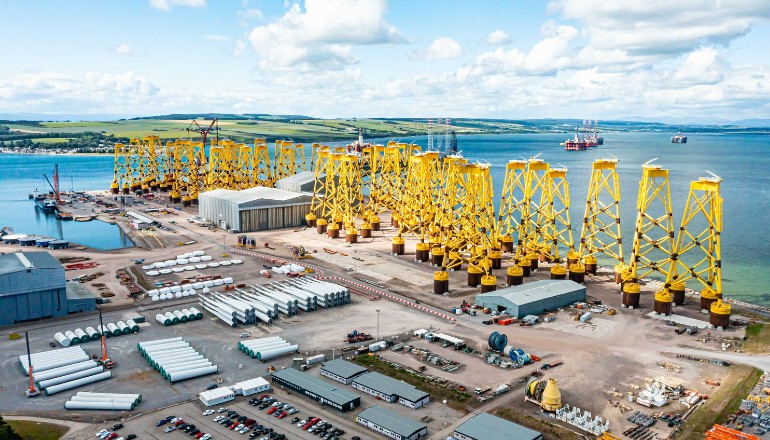
The award of Green Freeport status to two Scottish ports has been welcomed by bodies across Scotland’s renewable energy sector.
Opportunity Cromarty Firth and Forth Green Freeport were recognised under the UK and Scottish government-partnered scheme.
The awarding of Green Freeport status will provide the winners with a number of relief benefits such as tax breaks and rebates for green investment as well as simplified planning zones.
The other three applicants who were unsuccessful in their bids are Clyde Green Freeport, North East Scotland Green Freeport, which comprises Aberdeen City and Peterhead, and Orkney Green Freeport.
As part of the process, the successful locations had to demonstrate to officials and ministers from both governments how they would regenerate communities, deliver decarbonisation, establish hubs for global trade and foster an innovative environment to support levelling up.
Groups active in Scotland’s offshore wind sector have hailed the decision as a major boost for the industry.
Director for Capital Projects for Offshore at SSE Renewables, Steve Wilson said: “The Cromarty Firth has a key role to play in the delivery of Scotland’s renewable energy targets and particularly those for offshore wind and in ensuring that Scotland maximises the economic benefits from the growth of renewables.”
Scottish Renewables’ Head of Energy Transition and Supply Chain Emma Harrick noted: “The Cromarty Firth is a natural home for offshore wind with large areas suitable for the storage of parts and equipment, the capacity for significant expansion and plans to bring renewables manufacturing to the Highlands. The area also has the potential to enable the production, storage and distribution of green hydrogen at scale.
“The Forth region is already home to several offshore wind farms and the Green Freeport sites could act as gateways to those, as well as others which are yet to be developed. A proposed renewables hub at the Port of Leith, as well as an ambitious offshore renewables manufacturing facility at Rosyth, are exciting steps forward and will also benefit as part of the Forth Green Freeport plans.
“Both Green Freeports will help Scotland compete on the international stage as offshore wind develops to become the mainstay of electricity generation in the UK and we look forward to working with all partners to maximise the economic benefits which will be delivered.”
Brian McFarlane, industry co-chair of the Scottish Offshore Wind Energy Council, added: “The average Scottish supply chain spend from the proposed 20 ScotWind projects is estimated at £1.4bn per project built, and a significant proportion of this will need to flow through ports and the businesses clustered around them.
“However, the world-leading offshore wind pipeline we have in Scotland will require the involvement and support of multiple Scottish ports. That means it’s vital that we find routes to involve and support all the different ports who can support manufacturing, assembly, and the long-term operation activities required by offshore wind.”
David Rodger, CEO at Aberdeen Renewable Energy Group (AREG), commented: “Whilst it is very disappointing that Aberdeen and Peterhead were not chosen for Green Freeport status, the growing activity around transition and renewables in the Northeast, including hydrogen and offshore wind, means that the area will very much continue to play a crucial role in the delivery of world class energy projects and make a huge contribution to Scotland’s net zero goals and just transition objectives.
“Although two official winners were announced today, all ports involved in the five final bids stand to benefit from the huge volume of offshore wind and renewable projects on the horizon.
“Along with eight English freeports, the two Scottish freeports will bring economic benefits across the UK.”