


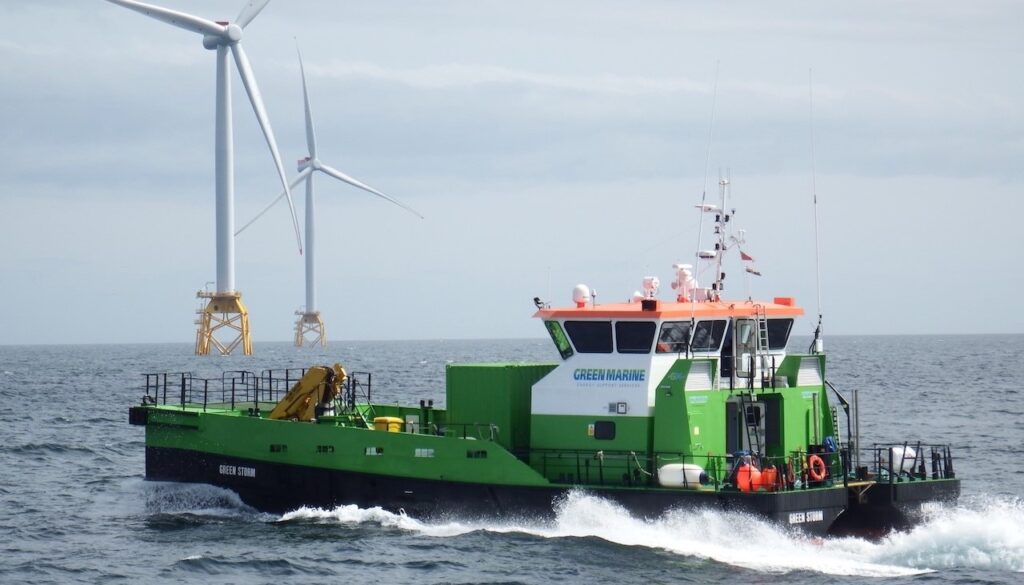
A scheme to retrofit a CTV with hydrogen fuel cells, to cut CO2 and NOx emissions while servicing offshore wind farms, has got underway.
Phase 1 of Project Verdant, which is supported by the UK’s national innovation agency Innovate UK, is now in progress involving a preliminary design and feasibility study.
If the concept is deemed viable, subsequent phases will seek to execute the concept design and test it in the field.
The project consortium is led by Orkney-based Green Marine and is being supported by project partners Waves Group and EMEC (European Marine Energy Centre).
Green Marine said the ultimate objective is to capture sufficient learning from the operation of a retro-fitted vessel to enable it to expand its fleet with new-build ZE (Zero Emissions) CTVs and ultimately SOVs, to support installation and maintenance activities in offshore wind farms in the UK and further afield.
The naval architect leading Project Verdant for Green Marine Jason Hayman said: “This is a highly ambitious project with potential to dramatically reduce the emissions associated with servicing and maintaining offshore wind farms.
“In recent years several new-build hydrogen-powered vessels have been launched, but our current objective is to develop a system that can be easily retrofitted to CTVs that would enable them to be powered by hydrogen fuels cells when in loiter mode for a substantial portion of the day.
“We are using new and innovative technologies, but we need to ensure that all aspects of our operation are inherently safe for our crew and passengers, and we need to be able to prove that to class and regulators.
“In the coming weeks and months, we will be engaging with industry leaders and technical experts to develop the design and specifications of the system.
“A viability assessment will then be undertaken to ensure any risks identified during the project can be adequately addressed or mitigated, and the design is capable of meeting or exceeding the criteria established.”
Project Verdant’s conceptual design incorporates hydrogen fuel cells that are connected to electric motors, which can work in conjunction with the existing diesel-fuelled engines, which can be shut down to enable zero emission operation at slow speed while working within offshore wind farms, Green Marine said.
This hybrid system could reduce the vessel’s CO2 emissions by up to 30% and NOx emissions by up to 40%, it added.