


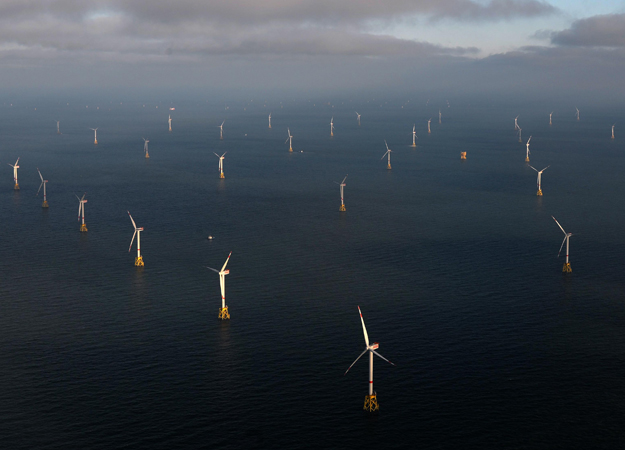
RWE has joined forces with ArcelorMittal to build offshore wind and hydrogen facilities that will service the steelmaker’s German operations.
A memorandum of understanding was signed to develop, build and operate the infrastructure that will supply the green hydrogen required to advance low-emissions steelmaking at ArcelorMittal’s sites in Bremen, Hamburg, Eisenhüttenstadt and Duisburg.
With the combination of RWE’s expertise in offshore wind farms and electrolysers, and ArcelorMittal as a guaranteed buyer of the green electricity and hydrogen, the two companies believe they have excellent opportunities for a viable partnership arrangement.
RWE and ArcelorMittal intend to conclude long-term purchase agreements for both wind power and green hydrogen.
RWE Renewables offshore wind CEO Sven Utermöhlen said: “Electricity from renewable energies and green hydrogen must become the hallmark of industrial production in Germany.
“Industry needs both in large quantities as soon as possible in order to achieve its climate targets. That is why we are planning one of the most ambitious expansion projects for offshore wind farms and electrolysers in Germany, together with ArcelorMittal.
“If the regulatory framework is right, we want to be successful together in the bidding for offshore areas. ArcelorMittal is an excellent partner to expand our industry cooperation and thus give real impetus to decarbonisation projects in Germany.”
In addition to the partnership on renewable electricity and green hydrogen, the companies want to investigate possible uses for ArcelorMittal’s low-emissions steel in components for RWE’s renewable electricity plants.
RWE aims to be climate-neutral by 2040 and to achieve this goal the energy company needs to decarbonise its supply chain, and the use of low-emissions steel will make an important contribution to this.
RWE and ArcelorMittal are also assessing options for joint participation in tenders for offshore wind farm sites in the North Sea.
The amendment of the Wind Energy at Sea Act (WindSeeG) currently underway is crucial for success, as it will permanently shape the cost structure in the German offshore wind sector.