


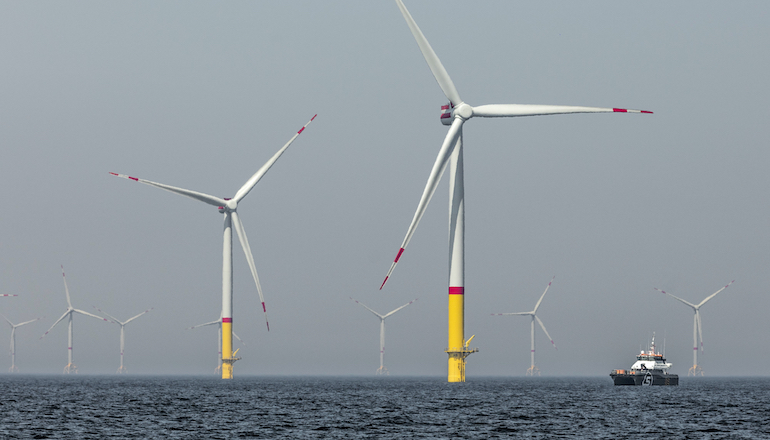
German companies RWE and BASF have revealed plans for a 2GW offshore wind farm that would supply the latter’s Ludwigshafen chemicals facility with electricity and provide power for a green hydrogen plant by 2030.
The chief executives of the companies – Martin Brudermuller (BASF) and Markus Krebber (RWE) – have signed a letter of intent to cooperate on the Lighthouse Offshore-to-X development.
The aim is to electrify production processes for basic chemicals that were previously based on fossil fuels, the duo said.
The project could avoid around 3.8 million tonnes of CO2 emissions a year, with up to 2.8 million tonnes of them directly at the Ludwigshafen facility.
Financial support from the public sector for the construction of the wind farm would not be required, the duo said.
However, they added that a corresponding regulatory framework is a prerequisite for the implementation of the project.
RWE and BASF said a tender for the 2GW wind farm should be in addition to the 20GW by 2030 that Germany already plans.
RWE would develop, build and operate the wind farm, with BASF owning a stake.
Around 300MW would be used to produce approximately 30 million kilograms of green hydrogen a year for use in other industrial segments.
Brudermuller and Krebber said: “Together we want to accelerate the path to a CO2-neutral chemical industry through electrification and the use of CO2-free hydrogen.”
Brudermuller said: “The transformation that lies ahead of us cannot succeed without sufficient quantities of electricity from renewable sources at competitive prices.
“This task can only be mastered through innovative and intensive cooperation between politics and industry. And it needs cooperation across value chains.
“In our partnership between RWE as a leading company in power generation and BASF in chemistry, we bring together the necessary prerequisites and the will to shape it.”
Krebber said: “Coupling a new offshore wind farm to an industrial customer such as BASF at the planning stage, who will convert its production to green electricity and hydrogen on this basis, would be a first for Germany.
“Realising our proposal would really accelerate the expansion of renewable energies. Of course there are still some questions unanswered, but we want to drive this forward: the faster, the better. This is how we shape the energy transition.”