


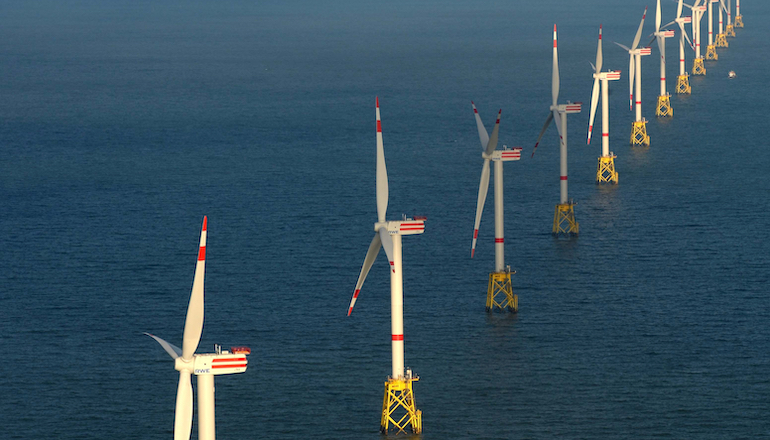
RWE and Commerzbank have signed a memorandum of understanding to set up a fund to give medium-sized industrial companies in Germany access to green electricity generated by offshore wind.
The ‘Green Mittelstand Fund’ will offer companies for the first time the opportunity to secure green electricity through long-term power purchase agreements (PPAs).
The duo said that up to now it has mainly been large industrial customers who have been able to sign such long-term PPAs with large-scale green electricity projects.
Medium-sized companies will be offered two options as part of this fund.
On the one hand, they can participate directly in the planned offshore wind farm with equity.
On the other hand, they can secure long-term green electricity via a PPA and thus achieve their decarbonisation targets. Both options can also be combined.
The planned wind farm is to have an installed capacity of around 1GW.
The companies want to apply for a seabed for the wind farm within the framework of future tenders, in accordance with the planned amendment to the German Wind Energy at Sea act.
These auctions are expected to take place in 2023.
RWE plans to hold 51% of the shares in the wind farm, the remaining 49% are to be offered to interested medium-sized companies by Commerzbank via the ‘Green Mittelstand Fund’.
RWE will develop, build and operate the wind farm and will commit to making the power generated there available to medium-sized companies.
Commerzbank plans to make green electricity directly available to its customers from the fund.
Commerzbank board member of managing directors for corporate clients Michael Kotzbauer said: “The ‘Mittelstand’ is what makes the German economy a success.
“With this innovative solution, we want to give these companies in particular access to green electricity production from offshore wind turbines and thus contribute to financing the energy transition in Germany.
“What is particularly attractive here is that our concept also offers investment opportunities in offshore wind that meet the electricity demand of medium-sized industrial companies.”
RWE chief commercial officer offshore wind Ulf Kerstin said: “Green electricity at competitive prices is the pledge of a sustainable industrial nation with a strong tradition of the ‘Mittelstand’.
Our concept opens up great opportunities for this because it can support companies and the energy transition.
However, the amendment to the legislation should be modified in such a way that it really does give a boost to the transformation of Germany as an industrial location because electricity from offshore can be offered at competitive prices.”
One prerequisite for this is to dispense with the negative bidding component, which the current draft law provides for, when designing the bidding conditions for offshore wind turbines on so-called non-pre-surveyed areas, the partners said.
This bid component would make green electricity unnecessarily more expensive for German companies, which are already facing record high energy prices, they said.
There is also a need for improvements in the criteria for the award procedure, the duo added.
They should be chosen in such a way that they allow differentiation between the bids and at the same time serve the overriding goal of providing green electricity in a smart and system-serving way, RWE and Commerzbank said.