


RWE has unveiled a new approach to supplier engagement, as it looks to expand investment opportunities in the Celtic Sea to a wider pool of UK businesses.
The developer’s strategy was launched at RWE’s Celtic Sea Supply Chain Engagement Day in Cardiff.
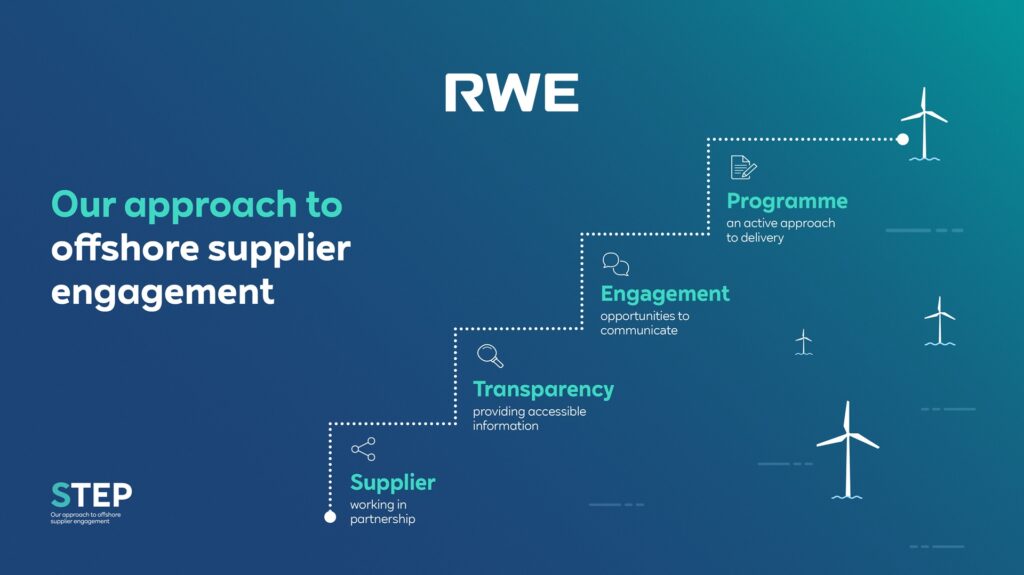
The initiative, the Supplier Transparency & Engagement Programme (STEP), aims to maximise awareness of opportunities for businesses to support the growing offshore wind industry.
The programme will enable a greater understanding of supplier capabilities, while enabling cooperative working with suppliers to help solve key industry and supply chain challenges.
There are four initial activities that showcase a commitment to effective supplier engagement.
These are new websites, an easy-to-use engagement platform with open search functionality and project updates, a full set of supplier engagement days, and the opportunity to arrange calls with project team members.
RWE’s director of development for UK and Ireland Danielle Lane said: “Floating wind is a new technology with huge opportunities and as such, businesses across south Wales and the south west of England have a real chance to place themselves right at the centre of the supply chain, for what is a multi-billion pound industry.
“RWE has been a major part of the UK’s offshore wind journey since the start, gathering significant experience across the development, construction and operations phases, in addition to supporting skills and training programmes.
“With a growing pipeline of floating projects globally, including unrivalled real-world experience via three separate demonstration projects, we are ready to bring that expertise to the Celtic Sea region.
“Combined with our long-standing presence in Wales as the country’s largest renewable energy generator where we employ over 300 staff Wales-wide, we also have the necessary resources to help put the region on the front foot.”
Wales Economy Minister Vaughan Gething said: “We are ambitious for the floating offshore wind sector in Wales – we believe it has the potential to deliver sustainable sources of energy into the future and it is also a once-in-a-generation opportunity to open up new markets for local suppliers and to create thousands of high-quality jobs in Wales.
“Open dialogue and discussion is the only way forward to help us make the most of the opportunities on offer – ranging from cutting edge technology to the local everyday economy.
“I look forward to many more opportunities to engage as we unlock the exciting potential this new industry has to offer to our businesses and communities.”
The STEP initiative builds on RWE’s approach to supplier engagement and furthers its global floating wind capability, which has been developing over the past four years, the developer said.
This has included multi-million pound engineering contracts and regular supplier outreach.
RWE’s Celtic Sea team has already been working closely with a number of potential key suppliers, including Tata Steel UK, ABP Port Talbot, Port of Milford Haven and Marine Power Systems.
The Crown Estate plans to allocate seabed rights in the Celtic Sea, estimated to be capable of generating four gigawatts of renewable energy by 2035, as part of a leasing round this autumn.
RWE is preparing to bid into the Crown Estate’s forthcoming Celtic Sea seabed leasing auction later this year, where up to 4GW of floating wind will be awarded, and many more gigawatts expected in the future.