


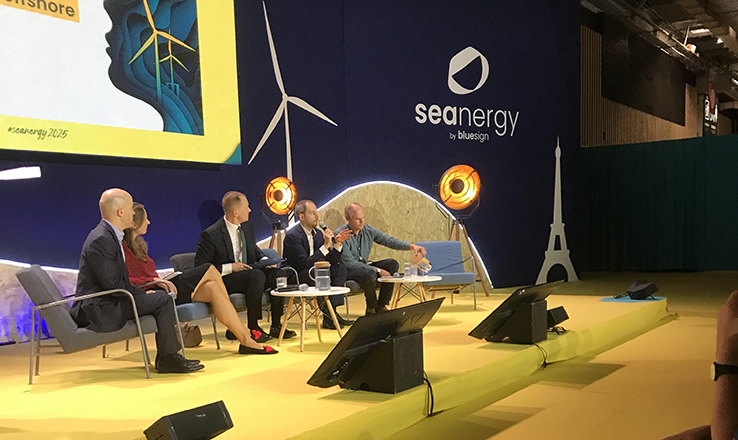
Half of banks investing in the offshore wind sector are more open to supporting projects with Chinese wind turbines than they were five years ago.
Speaking at the Seanergy conference in Paris, Bertrand Jacquet, director at Green Giraffe said that at the start of this decade no banks would look at funding an offshore wind project featuring Chinese wind turbines in Europe. However, he said the position had now changed due to reasons such as lower costs and squeeze in supply availability from European manufacturers such as Siemens and Vestas.
“Now banks are keener to entertain the possibility,” he said. “Half of banks are open to the idea now whilst the other half might look at it in the future. Bankability is vital if Chinese turbines are going to be used in Europe.”
He said that on paper it was a “no brainer” decision for developers to choose Chinese manufacturers. “They are 30% cheaper than their European competitors when built in China and 15% cheaper if built in a European factory. But you have to be able to finance the turbine. That’s not been done in Europe before.”
Jacquet was speaking at a roundtable on whether rising costs have been a good thing for the offshore wind sector. He argued that higher capex spending had been a positive in that it signalled the end of a “race to the bottom” in offshore wind.
“Because of the auction systems that were in place and the stiff competition the winning price went low,” he said. “That hit the margins, meant projects were not sustainable and put pressure on the supply chain.”
Alexander Vandenberghe, head of innovation at Wind Europe, however said that the rise in the cost of capital, primarily interest rates, had led to a slowdown in offshore wind projects reaching final investment decision (FID).
He reiterated a call to European governments to match their “very high ambitions” on offshore wind with the “right auction designs” namely two-sided contracts for difference.
“They provide stable revenues which is great news for investors,” he said. “We have seen governments who get auction designs wrong such as Denmark and Lithuania learn their lessons and move away from zero subsidies.”