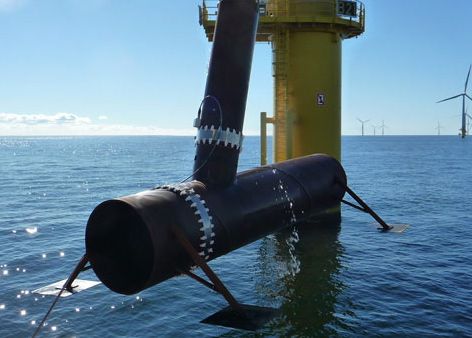
Researchers at the Fraunhofer Institute for Ceramic Technologies and Systems IKTS in Dresden have developed a sensor ring to help monitor for faults on offshore wind farm foundations.
In cooperation with Rostock-based Baltic Taucher, the researchers have tested the sensor in an on-site trial at the Baltic 1 offshore wind farm.
To take measurements, a diver connected a battery-powered handheld device to an interface port on the ring – a task that will be performed by a robot in the future.
The sensor uses ultrasound waves, which permeate the entire structure. If there is a crack somewhere, the waves will be reflected back from the damaged area.
Other sensors detect these signals, home in on the damaged areas and send data back to the handheld device.
For the trial, the researchers made a crack measuring 0.9 millimeters in width, 45 millimeters in length, and 7 millimeters in depth in a branched metal pipe, and lowered it to the bottom of the Baltic Sea at a depth of 18 metres.
The researchers said that the sensor located the crack with “excellent precision” and determined its length, height and depth.
They added that they are hopeful the system will be certified and ready for robotic operation in approximately five years.
IKTS project manager Andreas Schnabel said: “The heart of the system is the sensor ring, which is placed around the weld and remains there for the entire service life of the wind turbine.”
Image: the sensor during testing (Fraunhofer IKTS)
Sensor finds foundation faults
Researchers pilot device to check for cracks on offshore structures
 By EBS