


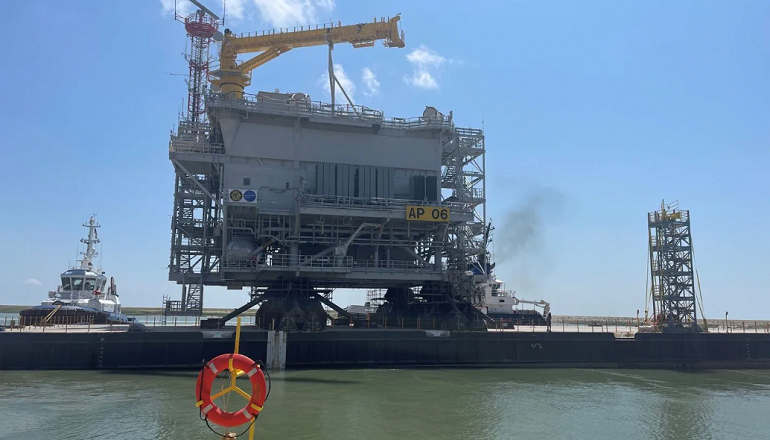
Orsted and Eversource have marked the “sail away” of the first American-built offshore wind substation, which departed a Texas fabrication facility on 24 May.
The substation is transiting across the Gulf of Mexico and then up the East Coast for installation at the South Fork Wind project site in a few weeks.
Kiewit Offshore Services designed and built the substation, which will be deployed at Orsted and Eversource’s South Fork Wind project serving Long Island, New York, set to begin operations by the end of this year.
Kiewit built the 1500-ton, 60-foot-tall substation at its Ingleside facility near Corpus Christi.
More than 350 workers across three states supported construction of this South Fork Wind substation, a topside structure that will sit on a monopile foundation within the wind farm, collecting the power produced by wind turbines and connecting it to the grid.
The substation was designed and engineered in Kansas, fabricated in Texas, and will be installed in New York.
“We’re putting American ingenuity to work as we build out a domestic offshore wind energy supply chain with investments and job opportunities spanning the Northeast, down to Texas and across the Gulf Coast region,” said David Hardy, Group EVP and CEO Americas at Orsted.
“The completion of South Fork Wind’s offshore wind substation is yet another first for this groundbreaking project and moves us one step closer to the project’s first ‘steel in the water.'”
Orsted and Eversource are growing an American offshore wind energy industry that’s creating jobs and driving economic development across almost every state in the nation.
South Fork Wind is now in its offshore construction phase, first with work to install the project’s submarine cable from its landfall below Wainscott Beach, in East Hampton, to the wind farm site east of Montauk, NY.
Cable laying is underway and installation of monopile foundations will begin in the coming weeks.
Vessels from several Gulf ports are supporting the construction of South Fork Wind.
South Fork Wind is expected to be operational by the end of 2023.