


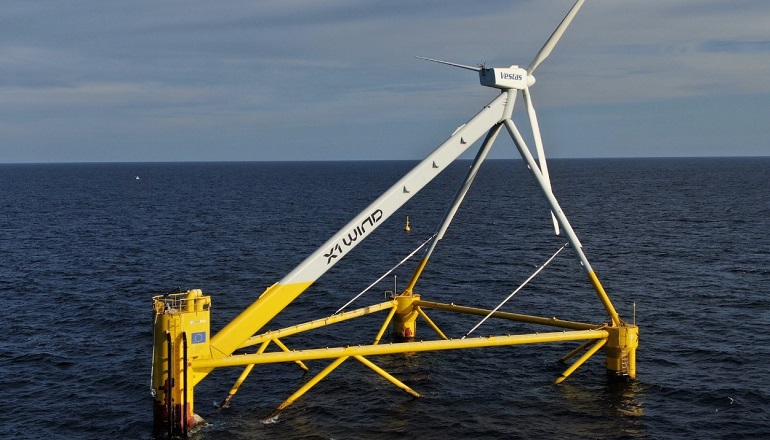
X1 Wind’s floating wind prototype, installed off Spain’s Canary Islands, has produced its first unit of electricity.
First power, from the PivotBuoy floating wind pilot was fed into the Plataforma Oceánica de Canarias (PLOCAN) offshore smart grid test site via a 1.4 km underwater cable connected to a 20kV transformer.
Local teams will now enter the last phase of a test and verification programme which started with the platform installation in November 2022, in preparation of the technology industrialisation and certification for commercial scale projects currently under development.
X1 Wind CTO and co-founder Carlos Casanovas said: “First power represents a huge milestone for X1 Wind, and the ‘lift-off’ moment we’ve been building towards for many years.
“The first kWh is always a symbolic moment for any new energy generation project, and for our team, partners and supporters, it crystalises the immense journey we’ve been on and the exciting path which lies ahead.
“Floating wind is set to play a vital role supporting the future energy transition, global decarbonisation and ambitious net-zero targets.
“Today’s announcement marks another significant stride forward for X1 Wind accelerating towards certification and commercial scale ambitions to deliver 15MW platforms and beyond in deepwater sites around the globe.”
The X30 platform is equipped with a specially adapted V29 Vestas turbine and ABB power converter.
Another key design feature, developed through the EU-backed PivotBuoy project, combines advantages of SPM and TLP mooring systems.
The proprietary SPM design enables the floater to “weathervane” passively and maximise energy yields, with an electrical swivel ensuring electricity transfer without cable twisting.
The TLP mooring system also reduces the seabed footprint, compared to traditional designs proposing catenary mooring lines, minimising environmental impact while maximising compatibility with other sea uses, in addition to its suitability to move into deeper waters
X1 Wind’s Electrical Engineering Manager Adrian Oliva said: “Now generating power, we’ve commenced a second phase to assess the floater behaviour during operation.
“This forms part of X1 Wind’s extensive testing verification programme to fully validate the platform in real world operational conditions and de-risk our technology.”
The X30 platform is equipped with all the electrical systems that the commercial platforms will contain, including a commercial turbine, power converter, transformer, slip-ring and dynamic cable as well as our in-house SCADA system with multiple sensors to control and monitor the platform’s behaviour in real-time.
PLOCAN CEO José Joaquín Hernández Brito added: “Spain has established itself as a global leader in innovative floating wind solutions, with numerous companies developing cutting-edge technologies, world-class research groups, and research centres.
“The government has also demonstrated its support for the sector by implementing new regulations (MSP) and funding initiatives to strengthen testing infrastructure and enable new pilots to advance these solutions.
“The PivotBuoy project is a prime example of success in this regard, and its accomplishments should inspire future endeavours.”
The PivotBuoy Project officially comes to a close on 31 March 2023, but X1 Wind has requested an extension of the testing period until May before decommissioning the prototype as foreseen in the EU funded project.