


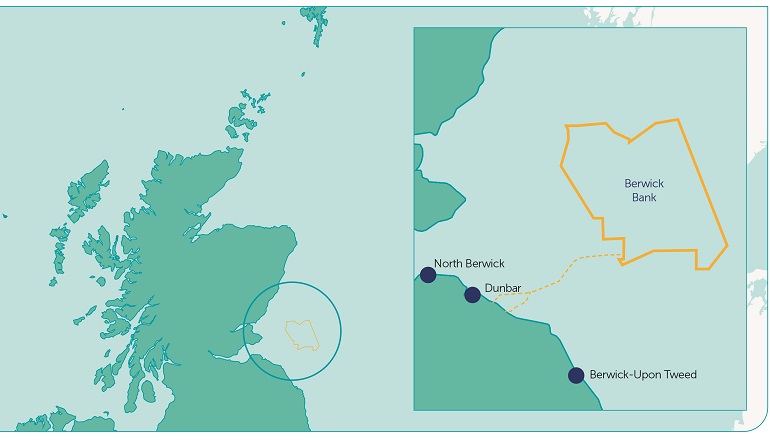
SSE Renewables has taken steps within its planning process to reduce the environmental impact of its 4100MW Berwick Bank Wind Farm, off Scotland, on seabird populations.
Following feedback from stakeholders, SSE Renewables will not be looking to develop the entire area available for Berwick Bank.
Instead, it will reduce the overall size of the site by around 10% compared to the area available for development in order to mitigate the potential impact on the local seabird populations.
Berwick Bank is also proposing to raise the minimum height of the turbine blades from 22m to 37m above sea level to address for bird passage through the site.
The news comes following the completion earlier this year of a 24-month aerial survey programme conducted by SSE Renewables and Hi Def Aerial Surveying.
The survey, consisting of 300 hours of flight time, across 5000 sq km, seven times the size of East Lothian, is believed to be the largest of its kind ever undertaken.
Berwick Bank project director Alex Meredith said: “Accelerating our efforts to decarbonise the electricity system must be done in harmony with our natural environment.
“Our surveys have shown that by increasing the air gap between the sea and the lowest blade height to 37m should have a significant positive impact on potential collisions.
“With these measures we want to minimize any potential impact that Berwick Bank Wind Farm has on the local seabird populations, particularly kittiwake and guillemot whilst also recognising that climate change is a key threat to these species”
HiDef commercial director Martin Scott said: “Reducing impacts to birds has been a major priority for the project throughout.
“It is known that higher densities of birds fly closer to the sea surface. By creating a larger airgap this increases the likelihood of birds being able to pass safely under the turbines and reduces the potential for collision risk with the moving blades.”