


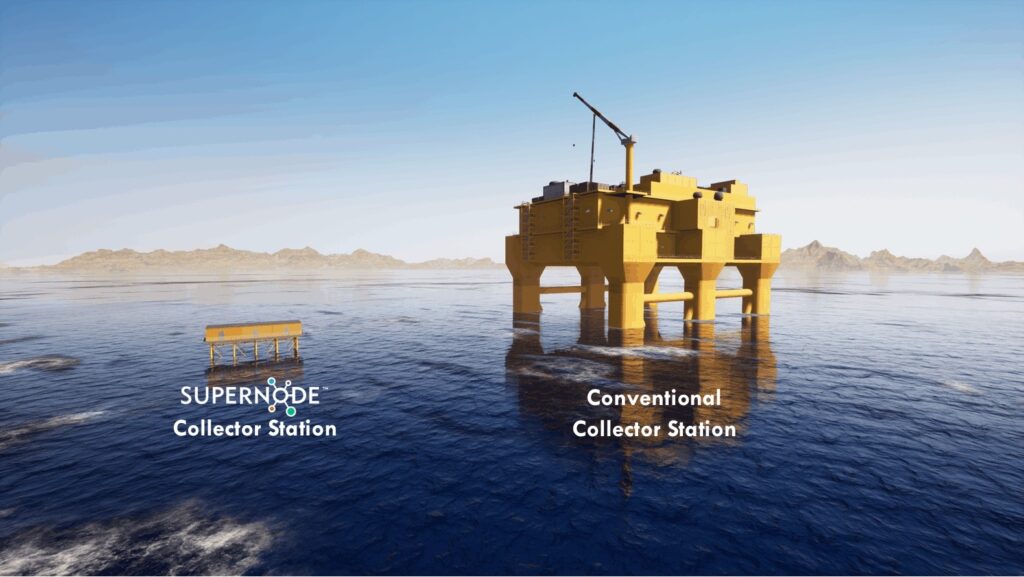
SuperNode and Irish research institute MaREI have launched a collaborative project to facilitate up to 10x faster offshore renewable development globally.
The SuperNode concept is focused on providing a single superconductor connection to offshore renewable energy sources.
The technology aims to achieve efficient delivery of power back to shore by operating at medium voltage, direct current, and facilitating transmission from energy dense areas offshore to high demand locations via a subsea superconductor.
SuperNode says its technology has the potential to transform the electric power transmission industry and move Europe towards its carbon reduction targets for large scale power generation.
SuperNode chief executive John Fitzgerald said: “This is an early and significant step in developing this game changing technology to enable more renewables.
“Direct current is the most efficient way to transport energy over distance on the planet.
“What superconducting cable systems do that other cables do not is allow higher currents and hence more power to flow on a single circuit.
“This enables very large offshore wind developments to be phased, grouped and networked to deliver more clean energy faster.”
The scheme is jointly funded by SuperNode and a grant from Science Foundation Ireland through the MaREI research centre.
The project team of five includes three positions at MaREI and the creation of two new full-time positions within SuperNode.
SuperNode chief technology officer Eoin Hodge added: “The entire SuperNode team is very excited to work with MaREI on this challenging engineering endeavour to make significant progress towards delivery of our disruptive, advanced Superconductor technology, potentially a key part of Europe’s transition to a low carbon future.”
The project aims to advance the performance of SuperNode’s Subsea Superconducting Cable System design which is expected lead to the construction of a set of test facilities for the system.
The test facilities will enable testing of SuperNode’s cable system at its operational temperature of almost -200C and its durability against the forces that it will have to withstand during its construction and 30+ years of operation on the seabed.
Superconducting cables have been operating for several years onshore in places like Essen in Germany and Shingal in Seoul with a larger installation coming online in Munich in the next few years.
However, existing onshore superconducting cable systems are not fit for purpose for the offshore environment, nor for the amounts of electrical power required to support a renewable grid onshore.
To deal with marine conditions and larger flows, accessing the best renewables, SuperNode is developing a new system.
This project aims to improve these superconducting systems by testing physical prototypes to determine their suitability for subsea operation. This will be achieved through a range of numerical modelling and physical testing activities.