


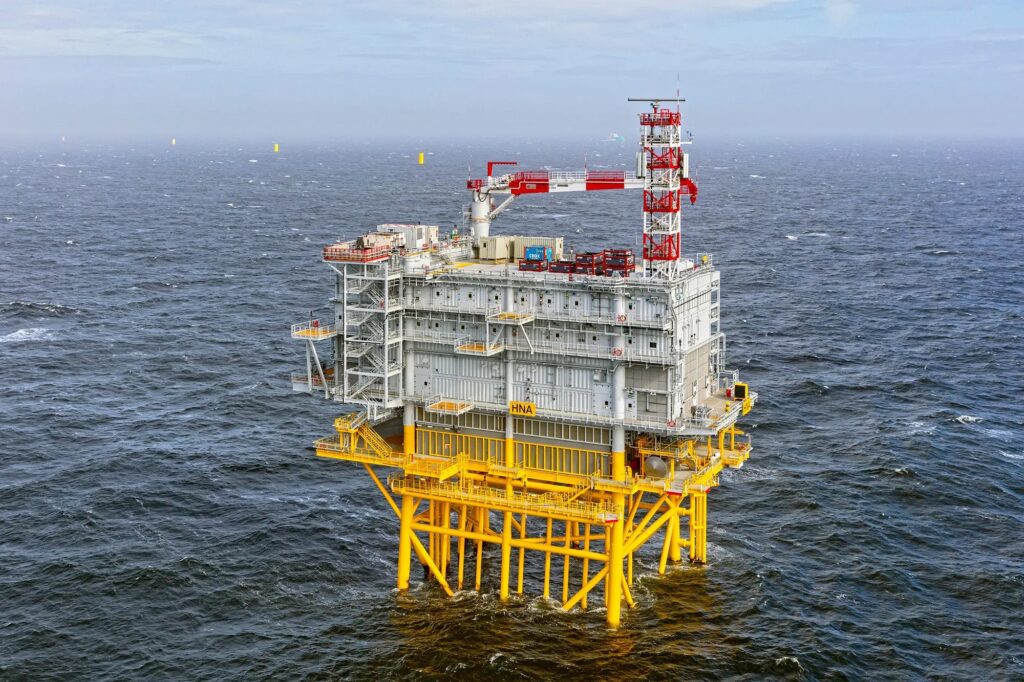
TenneT has announced that the grid connection for the 759MW Hollandse Kust (noord) wind farm is ready for commissioning.
This means that Eneco, Shell JV CrossWind will be able to connect the 69 wind turbines, which will be located some 20 kilometres off the coast of Egmond aan Zee, to TenneT’s “offshore socket”.
It has been agreed in the Energy Agreement that at least 4500MW of installed wind capacity at sea will be realised by the end of 2023.
These wind farms annually generate an amount of electricity that is comparable to the annual consumption of five million households.
TenneT has been commissioned by the government to realize five standardized grid connections of 700MW each.
From 2019, TenneT has delivered a connection from sea to land every year.
Marco Kuijpers, director of large projects offshore at TenneT, said: “I look back with pride on what we have achieved with the government, contractors, the wind sector and all other stakeholders.
“This cooperation gives confidence for the future. Together with Hollandse Kust (noord), we will deliver the fifth and final 700MW connection from the Offshore Wind Energy Roadmap 2023 this year, safely, within time and budget.
“Added together, the installed capacity of all offshore wind farms is then 4.7 GW.
“The Netherlands thus achieves the important objective in the Energy Agreement.”
Following the last series of tests, grid operator TenneT received the “grid ready” certificate on 31 March.
“This means that the complete connection – from our transformer platform at sea to the high-voltage substation along the A9 motorway near Beverwijk – is officially ready to bring green energy ashore”, explained Arjan Dams, project director of the Hollandse Kust (north) (west Alpha) project. ) and (western Beta).
“In good cooperation with the contractors, the authorities involved and the environment, this project was carried out within time, scope and budget.”
From the socket at sea, the electricity from ‘north’ comes ashore at Heemskerk beach via two electricity cables in the seabed.
From there, the cables pass under the dunes and the electricity, via the first part of the underground cable connection on land, arrives at the new transformer station in Wijk aan Zee.
From there, the electricity is fed underground about ten kilometers away by TenneT at the correct voltage into the national high-voltage grid.
The last part of the second sea cable is currently being installed for the grid connection of “west Alpha”, TenneT said.