


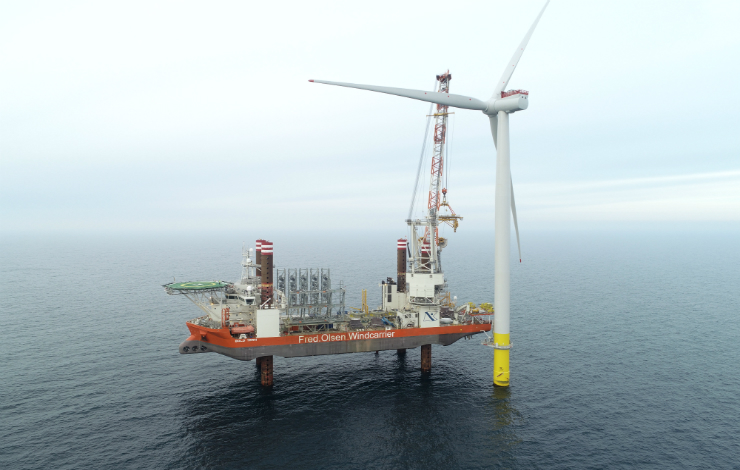
The development of bigger and more powerful offshore wind turbines is currently outpacing the infrastructure capacity needed to install them, according to a new report from IHS Markit.
According to its clean energy technology service, offshore wind annual gross capacity additions are expected to grow sixfold by 2030 due to dramatic cost reductions, advances in technology, favorable policies and ever-increasing national targets.
However, the industry needs to rapidly develop and invest in new infrastructure to achieve these ambitious plans, its Offshore Wind Turbine Installation Vessels report says.
Most critically, the current offshore wind turbine installation vessel (WTIV) fleet is unable to install the new larger 15MW+ turbines that will be hitting the market in the next three years.
IHS Markit’s principal analyst for clean energy technology Andrei Utkin said: “Offshore wind turbines are constantly getting bigger and more powerful, reducing costs, improving competitiveness and opening new markets.
“However, that presents a new challenge.
“As new developments are moving further offshore and into deeper waters, logistics, transit and installation become more complex and require larger specialized self-propelled jackup vessels with technical capabilities far beyond the existing fleet.”
The geographical distribution of the global WTIV fleet, currently comprising around 50 vessels with two-thirds located off mainland China and most of the rest in Northern Europe, presents a further immediate challenge to offshore wind targets, according to the report.
The Chinese fleet does not operate internationally, at least at this point, and much of the remaining global fleet is concentrated around and busy working in the North Sea, requiring significant time and expense to travel for installations elsewhere.
Countries outside these regions will therefore face significant roadblocks to expanding offshore wind capacity unless new vessels for other regional markets are rapidly built, the report concluded.
The United States has targeted a particularly ambitious offshore wind goal of 30GW by 2030, but despite the restrictive terms of the Jones Act, the only US–built and flagged WTIV is not set to enter service until 2023.
In order to hit its target, the country must either relax its maritime rules to permit foreign-built vessels to operate or ensure new heavy-weight vessels are built and put into service promptly, the report states.
IHS Markit projects that the industry will need to invest a minimum of $1.2bn to $2bn (€1bn to €1.7bn) to build at least four new vessels to meet global demand from 2026, outside of mainland China.
Depending on where these vessels are built, the total cost may be significantly higher if local content requirements are taken into consideration, particularly in the emerging offshore wind markets of the United States and Asia Pacific.
Utkin added: “Although six new vessels currently under construction are expected to come online by 2023, absent further investment the global fleet would still experience difficulties to cover the global demand in 2026−27 and would most certainly fail to do so post-2028.
“As a result, at least four additional WTIVs are needed to cover the expected demand to 2030.”
While seven companies have announced the intention to build up to 16 new vessels, these are not firm contracts and final investments have yet to be secured.
But the report found conditions for investment are improving as turbine sizes stabilise and the technical capabilities for installing them become increasingly standardised.
Utkin concluded: “One of the reasons for the lack of investment in newbuild turbine installation vessels in the past was concerns over the longevity of the vessels as turbine technology was developing rapidly.
“Now that turbine sizes have somewhat stabilised, with more standardized technical capabilities required for vessels, you are finally seeing newbuilds being ordered.
“We expect that with the rise of the emerging offshore wind markets and first commercial projects coming online, investors and owners will be increasingly willing to finance and build new vessels.”