


A collaboration of UK green technology pioneers has been awarded grant funding to install the world’s first offshore charging station within a UK wind farm.
The finance has come from a share of the Department for Transport and Innovate UK’s £60m Clean Maritime Demonstration Competition (CMDC)
Project leaders Oasis Marine have partnered with Turbo Power Systems, Verlume and ORE Catapult to deliver the world leading Offshore Charging Station.
This smart energy storage and charging infrastructure will enable fully electric maritime operations within offshore wind farms.
During the two-year project, offshore charging infrastructure will be developed for charging hybrid and electric crew transfer vessels (CTVs) and will be demonstrated over two phases.
The first will prove the transfer of power utilising Verlume’s battery and intelligent energy management technology, to charge a vessel via the Oasis Power Buoy while at sea.
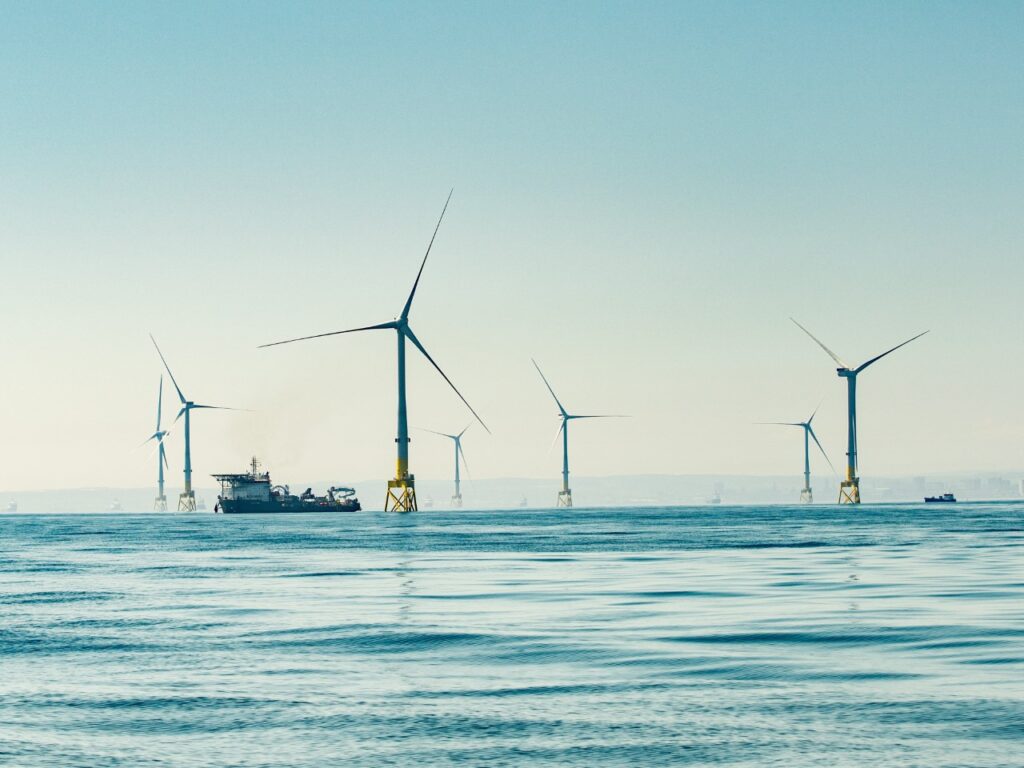
During the second phase the project will work with Vattenfall regarding technical and regulatory developments, aiming to lead to an on-turbine demonstration at their European Offshore Wind Deployment Centre (EOWDC) within Aberdeen Bay (pictured).
AC power generated by the existing wind turbines will be supplied via Turbo Power Systems high power charging solution to the Oasis Power Buoy.
During the demonstration a hybrid CTV would operate from Aberdeen Harbour to the wind farm, to then connect and recharge from the Oasis Power Buoy whilst waiting in field as maintenance technicians work on the turbines.
A major barrier for the decarbonisation of the maritime sector is the range and duration at which electric and hybrid vessels can operate.
Currently vessels can only be charged within ports and most wind farms are too far from shore to allow journeys to be fully completed on battery power.
Enabling offshore charging from a zero-emission energy source will allow CTVs to operate on electric power for the majority of the time, extending operational range and significantly reducing emissions.
This breakthrough technology will enable full electric operation in the future, the consortium said.
Håkan Borgström, deputy director on the O&M product line at Vattenfall said: “The electrification of the vessels is an important requirement and the charging infrastructure an essential component.
“Vattenfall’s European Offshore Wind Deployment Centre at Aberdeen provides a great location for the demonstration of the Oasis Power Buoy and with our expertise we can support its implementation.
“For us is this an important step to decarbonise the logistics in the wind farm and part of our ongoing mission to deliver fossil-free living within a generation.”
Lauren Hadnum, clean maritime manager at ORE Catapult added: “Recharging in field is a critical enabler for the deployment of more electric support vessels.
“This project is an exciting step in demonstrating not only recharge at sea, but also integration with a working wind farm.
“We are pleased to be able to support this SME-led project to deliver an industry ready solution for CTVs by 2025.”
Crew transfer vessels will be the primary focus of the project, however the concept could also be scaled for larger service operations vessel (SOV) daughter craft which are considered an emerging vessel type set to increase in numbers rapidly as wind farms move farther from shore.