


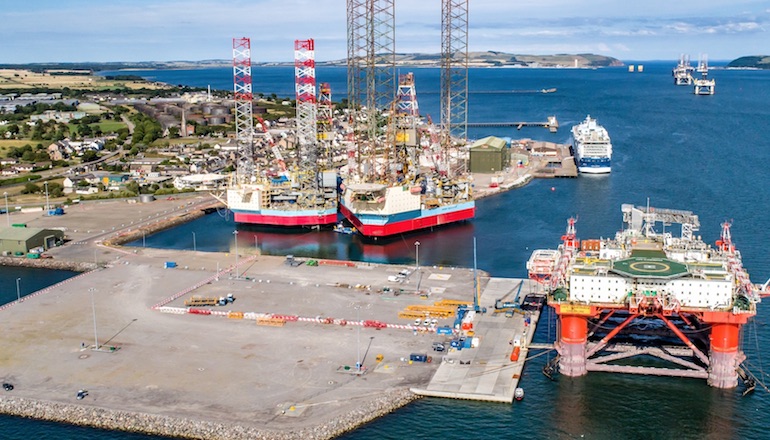
A new report by the Floating Wind Offshore Wind Taskforce says up to 11 ports around the UK will need to be transformed as fast as possible into new industrial hubs to enable the roll-out of floating offshore wind at scale.
The report contains a series of recommendations which could see 34GW of floating wind installed in UK waters by 2040 if the government takes swift and decisive action.
At present ministers have set a target of 5GW by 2030.
The Taskforce includes the UK, Scottish and Welsh Governments, the Northern Ireland Executive, major offshore wind and port developers, The Crown Estate, Crown Estate Scotland, RenewableUK, Scottish Renewables, the Offshore Renewable Energy Catapult and other key stakeholders.
The UK is well positioned to become a global leader in cutting-edge floating wind technology, with the biggest project pipeline in the world of 37GW (one-fifth of the global pipeline) and the potential to create tens of thousands of new jobs and attract billions in private investment.
Floating wind farms can be built in deeper waters, further from the coast, where wind speeds are even higher.
The report highlights the fact that this technology will play a key role in decarbonisation and that it is essential for the UK meets its energy security and net zero targets.
To enable the UK to scale up, the report recommends developing ports as soon as possible by investing £4bn to ensure they are ready for mass floating wind deployment by the end of this decade.
Port upgrades are needed to enable turbines with hub heights taller than 150 metres and their giant floating bases to be manufactured and assembled in coastal locations, according to the report.
The initial focus will be on Scottish ports and the Celtic Sea (Wales and the south west of England) where floating projects are currently being planned.
The report states that initially, a minimum of three to five ports will be needed in Scotland to install turbines onto the floating bases, with a further two ports needed to service the Celtic Sea sector.
Additionally, at least four other UK ports will need to be revitalised for manufacturing massive steel and concrete components for floating foundations.
More ships and bigger cranes will also be required in the construction process, creating further industrial opportunities – particularly as there is strong international competition for these among both floating and fixed-foundation offshore wind developers.
The report notes that implementing the recommendations required to reach 34GW of floating wind by 2040 will generate £26.6bn in additional GVA (total economic activity) in the UK, which in today’s value is about £18bn.
It calculates that every £1 invested in UK port facilities would generate up to £4.30 of added value to the economy, and by 2040, the floating offshore wind industry will support 45,000 jobs across the UK.
RenewableUK’s emerging technologies policy analyst Laurie Heyworth, who worked on the report with engineering consultants Royal HaskoningDHV, said: “Getting onto the front foot to make the most of our enormous floating wind resource is essential to boost Britain’s energy security and deliver net zero as fast as possible.
“At the moment there are no port facilities in this country which are fit for the mass deployment of floating wind, so we need to start revitalising them now as new industrial hubs, so that we’re ready for this sector to take off at scale by 2030.
“The timeline is tight and we will only be able to deliver on our ambition if we take action promptly and decisively.
“The UK has the largest pipeline of floating wind projects in the world.
“We’re determined to ensure that we maximise the benefits of this innovative industry by capturing significant market share not only in this country but also by exporting our technology and expertise globally.
“Four-fifths of the world’s potential offshore wind resources is in deeper waters, so floating wind is a key technology which industry and government must ramp up now, so that we can maintain our global lead in the decades ahead.”