


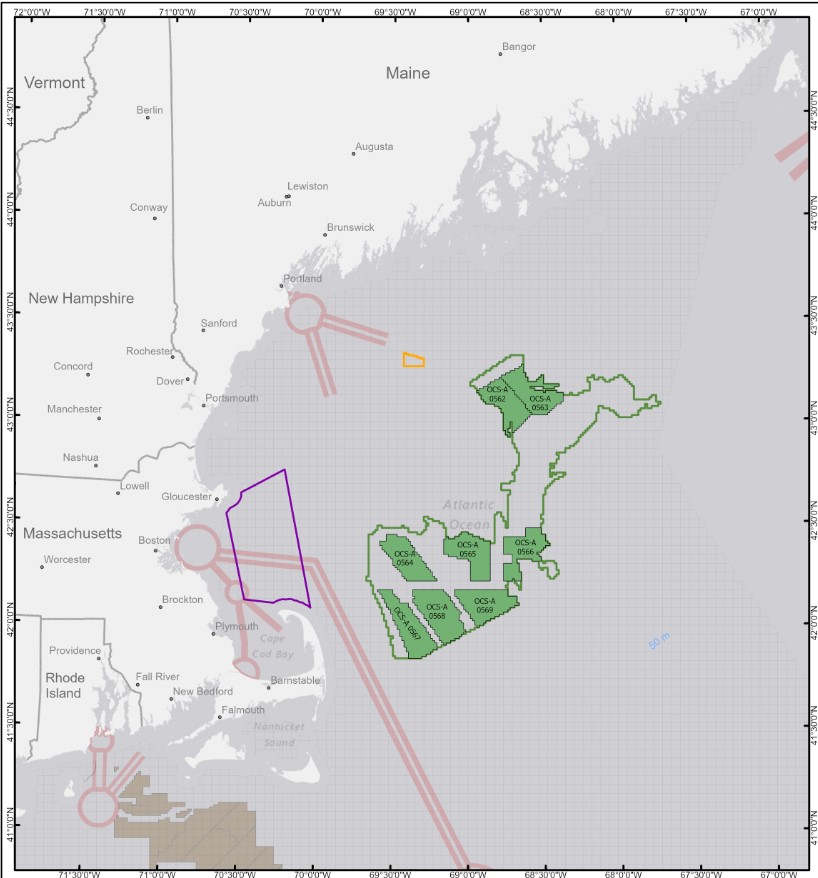
Avangrid and Invenergy have secured two leases each in the Gulf of Maine auction after bidding a total of almost $22m.
Avangrid secured OCS-564 for $4.9m, which consists of 98,565 acres and lease OCS-568 for $6.2m, which consists of 124,897 acres.
Both lease areas are approximately 29.5 nautical miles (nm) from Massachusetts.
Invenergy NE Offshore Wind won area OCS-562 for $4,9m, which consists of 97,854 acres and is approximately 46.2 nm from Maine.
It also landed lease OCS-567 for $5.9m which consists of 117,780 acres is approximately 21.6nm from Massachusetts.
Together, the leased areas have the potential to power more than 2.3 million homes with clean energy, according to the Bureau of Ocean Energy Management.
“Since the start of the Biden-Harris administration, we’ve been committed to achieving our ambitious clean energy goals,” said Secretary of the Interior Deb Haaland.
“With ten approved offshore wind projects capable of powering over 5 million homes, we are well on our way to a clean energy future.
“Today’s successful auction marks yet another critical step in our fight against climate change. Together, we can create good paying jobs, build a domestic supply chain, and ensure that the momentum of this offshore industry continues for generations to come”
“To ensure we got the process of bringing offshore wind to the Gulf of Maine right, we’ve engaged in over a hundred outreach efforts with local communities and connected with thousands of partners and stakeholders,” added BOEM Director Elizabeth Klein. “Collaboration with partners and stakeholders is key to making progress. By working closely with states, Tribes, ocean users, and industry leaders, we are building a sustainable new industry that will meet our nation’s current and future energy needs.”
Today’s sale resulted in over $5.4 million total bidding credits. These bidding credits represent binding commitments by companies to invest over $2.7 million in workforce training and domestic supply chain development, and an additional $2.7 million for fisheries compensatory mitigation.
In addition, lease stipulations require that the lessees make every reasonable effort to enter into a project labor agreement covering the construction stage of any project for the lease areas; develop communication plans for engagement with Tribes, agencies, and fisheries; and provide semi-annual reports on engagement activities with Tribes and communities.
The leases awarded today do not authorise the construction or operation of any offshore wind facilities. Rather, they provide the right to submit a project plan for BOEM’s review.
BOEM will develop an Environmental Impact Statement (EIS) to analyse the specific impacts of any project proposals before making decisions on whether to approve a proposed construction and operations plan.
The EIS will be prepared in consultation with Tribes and appropriate government agencies, and informed by input from stakeholders, ocean users, and the public.
BOEM earlier kicked off bidding for eight areas off Maine and Massachusetts that can host around 13GW of offshore wind projects.
It is understood there were no bidders for the other four remaining sites.