


A three-year study has started off the coast of southern New England to look at how offshore wind farm development could impact Atlantic cod and other commercial fish species.
The Bureau of Ocean Energy Management-funded programme aims to gather baseline data in order to asses wind farm impact on fish.
Participants in the study are NOAA Fisheries Northeast Fisheries Science Center and Greater Atlantic Regional Fisheries Office, Woods Hole Oceanographic Institution, Massachusetts Department of Marine Fisheries, The Nature Conservancy, University of Massachusetts Dartmouth School for Marine Science & Technology, and Rutgers University.
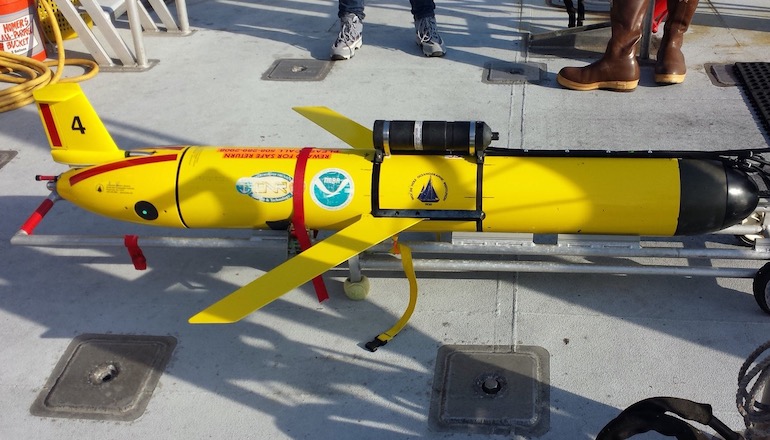
An autonomous underwater glider (pictured) is surveying areas in and around Cox’s Ledge, including the South Fork wind energy lease area south of Rhode Island and Massachusetts.
The glider has a hydrophone to detect fish spawning sounds and an acoustic telemetry receiver to detect tagged fish.
The receiver will identify location and seasonal occurrence of hotspots for key commercial and federally listed fish species.
Project lead Sofie Van Parijs said there is little information on Atlantic cod spawning specific to southern New England waters.
Cod elsewhere are known to form large, dense spawning aggregations in predictable locations relatively close to shore, where they can be vulnerable to disturbance that might affect spawning success, she said.
Van Parijs also heads the Passive Acoustics Research Group at the Northeast Fisheries Science Center laboratory in Woods Hole, Massachusetts.
She said: “Biological sampling will determine the population’s onset of spawning and track growth, maturity, age structure, and other life history parameters.
“This information will help inform the starting date for our glider surveys each year. We will tentatively conduct these surveys from December through March this year and for longer periods in the subsequent two years.”
Researchers will tag up to 100 spawning cod with acoustic transmitters that the glider can detect to identify areas where spawning is occurring.
Sensors on the glider will also collect detailed environmental data to better understand the temperature preferences and habitat use of Atlantic cod off southern New England.
Orsted will also use glider detection of endangered whales to help with monitoring and mitigation requirements in the South Fork wind energy lease area.
They expect to begin construction of the wind farm as early as 2021.
A new near real-time telemetry system is operating, detecting whales and fish.
Researchers are also using local vessels to conduct the field work for the project.
They have deployed an array of 10 bottom-mounted acoustic telemetry receivers in and around the South Fork wind lease area.
This array tracks movements and residency patterns of spawning cod, and will be expanded in the future.