


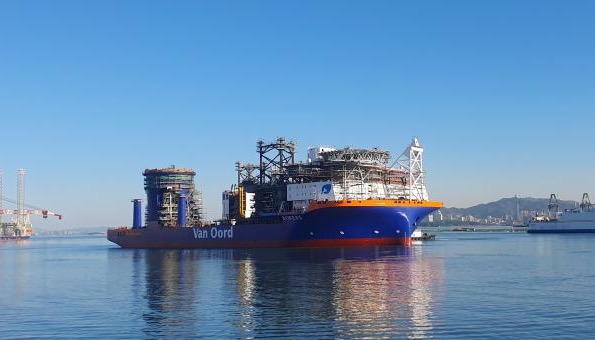
Van Oord’s new offshore installation vessel Boreas has been successfully launched at the Yantai CIMC Raffles Offshore shipyard in China.
Boreas’ dual fuel engine set is able to run on methanol and is purpose-built for the transport and installation of the next generation foundations and turbines at offshore wind farms.
Commercial availably is expected in 2025.
Upon completion, Boreas will be the largest vessel of its kind, Van Oord said.
Because of its size, the launch was a challenging job, it added.
First, it had to be moved from the construction site to the quay, using the so-called ‘skidding method’, involving the horizontal transport of heavy and oversized objects along a linear track.
The vessel was then skidded from the quay onto two pontoons.
These pontoons were later submerged in a controlled operation after which Boreas became afloat.
After safely moored alongside, the works on the vessel will continue with the installation of the main crane and the extension of the legs of the jack-up.
Meanwhile the ship’s technical installation will be further commissioned, after which sea trails will take place to test performance.
Subsequently, Boreas will be handed over by the shipyard to Van Oord.
Project manager shipbuilding at Van Oord Johan de Graaf said: “The launch of Boreas is a major milestone for Van Oord.
“A big thanks to the project teams and all subcontractors and suppliers who worked with great commitment and dedication towards this crucial stage of the construction process.
“With Boreas now afloat, we’re entering the final stages of the newbuilding, and we are excited to continue our journey towards successful delivery.”
The vessel measures 175 metres in length and has a crane with a 155-metre-high boom, able to lift over 3000 tonnes.
Four giant legs, each measuring 126 metres, allow the vessel to be jacked up and work in waters up to 70 metres deep.
It will therefore be able to install the next generation of 20MW offshore turbines, Van Oord said.
Being an example of the energy transition within Van Oord, Boreas is the first of its kind to be able to run on the future fuel methanol, reducing the ship’s carbon footprint by more than 78%, it added.
Furthermore, the vessel will be equipped with a cutting-edge active emissions control technology (Selective Catalytic Reduction) to reduce the NOx emission to an absolute minimum.
A battery pack of about 6000kWh can take peak loads and regenerate energy to reduce the fuel consumption and corresponding emissions even further.