


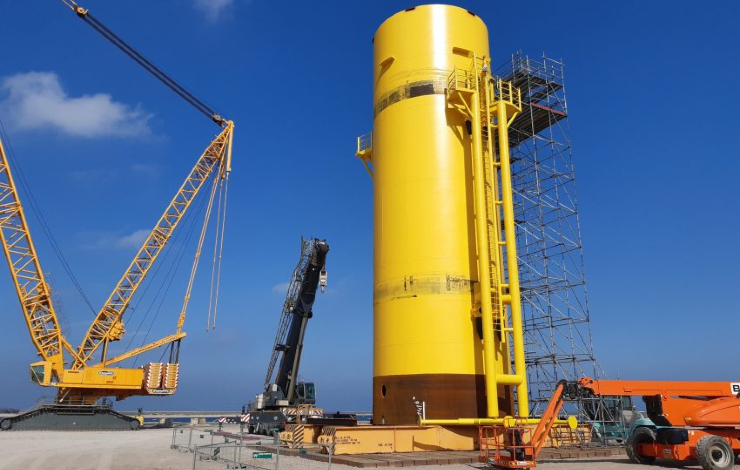
Vattenfall has completed tests of installation methods for the integrated monopile and transition piece foundations that will feature at its 1500MW Hollandse Kust 1-4 complex off the Netherlands.
The trials were carried out at the Sif Netherlands site in Maasvlakte and used a 220-tonne mock-up foundation that was 22 metres tall and seven metres in diameter.
The tests focused on how secondary steel such as boat landings and ladders will be added onto tubulars once they have been hammered into the seabed.
“When we perform the test, we constantly ask ourselves: ‘What if we do this at sea? What are the conditions like there?’ said Vattenfall’s Bart Buisman who managed the test phase.
“That is why we simulate the installation conditions as they probably would be at sea. For example, we deliberately hung the external work platform on land a little tilted in the crane.”
Vattenfall will use the tests to inform the final methodology for the installation of 140 foundations at the project next year.
Seaway 7 will start installing the Sif-built units in summer.
Vattenfall has also completed UXO inspection and removal across half of the Hollandse Kust Zuid 1-4 complex.
The developer found and removed 30 items as part of a recently concluded three-month campaign.
The campaign investigated previously identified targets at the HKZ 1&2 project sites.
“Four percent of the targets inspected were UXO, the vast majority of which came from World War II,” Vattenfall senior geophysicist Eoin McGregor said.
“These were mainly bombs, naval mines, machine guns and ammunition boxes. The other ninety six percent was mostly metallic debris.”
A campaign at the Hollandse Kust Zuid 3&4 sites will be carried out shortly.
The Hollandse Kust 1-4 complex is due online in 2023 and will feature 140 Siemens Gamesa 11MW turbines.