


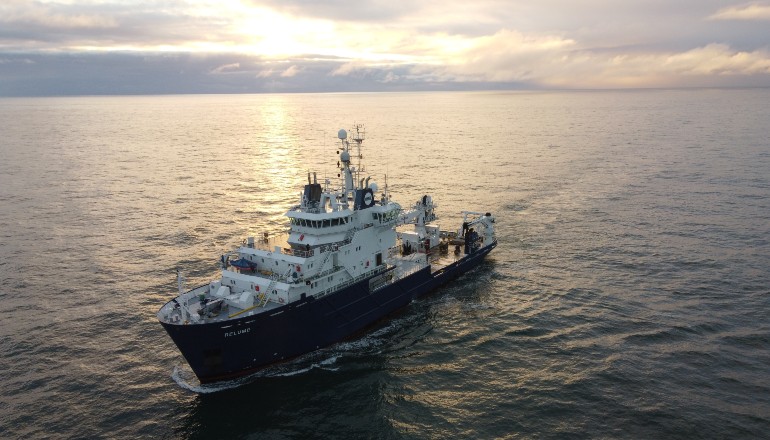
The developer of the West of Orkney Windfarm has completed its 2022 offshore surveys for the project area, located around 25km north of the Sutherland coast.
The 2GW project is a joint venture comprising Corio Generation, TotalEnergies and Renewable Infrastructure Development Group (RIDG) and is scheduled to be generating electricity by 2029.
The new milestone covers geophysical and benthic surveys of the seabed across the 657 sq km offshore option agreement area, with the objective of establishing the project ground model and habitats map.
The information collected, alongside three seasons of bird and marine mammal surveys which were completed in September, keeps the West of Orkney team on track to submit onshore and offshore consent applications next summer.
The bird and marine mammal surveys were carried out by HiDef Aerial Surveying Limited using high-resolution digital cameras mounted on aircraft. This high-definition information gives the project confidence they are recording and identifying all of the different species that which might be found at the offshore wind farm site.
In addition, nearshore geophysical and geotechnical surveys were completed along the offshore cable corridors.
The offshore seabed surveys commenced in early April 2022, with seabed survey specialists Ocean Infinity using their vessels MV Relume and MV Geo-Ranger, operating out of Scrabster Harbour.
Survey contractors Ocean Infinity and Spectrum performed the work, with Ocean Infinity also responsible for the shallow geotechnical work on the cable corridor whilst the nearshore geophysical survey was completed by Spectrum using the vessels Spectrum 1 and Spectrum Nyquist and a photogrammetry aerial drone.
“We are delighted the seabed survey work has been completed safely, on schedule and within budget, with no lost time incidents. This leaves the project ideally placed to advance our windfarm design and progress with our consent applications next year as planned,” said Stephen Kerr, Project Director of the West of Orkney Windfarm.
“The offshore geophysical survey work covered an area of leased seabed 1.5 times the size of Edinburgh and, during the six-month programme, the main survey vessel travelled more than 17,000km – equivalent to the distance between London and Sydney. The geotechnical campaign included 50 cone penetration tests and 50 vibrocores along the cable route. The nearshore survey vessels covered over 500km in total.”