


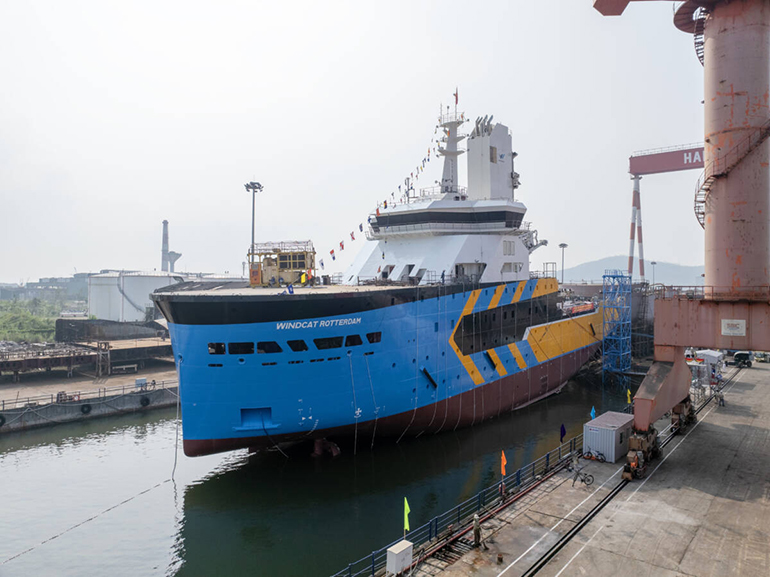
Windcat’s first Commissioning Service Operation Vessel (CSOV) has been launched by Damen, the first of six such craft.
The launch marks the inauguration of Windcat’s ‘Elevation Series’ of future-proof offshore wind farm maintenance and support ships, designed in collaboration with Windcat and CMB.TECH.
The launch ceremony took place at Ha Long Shipyard in Vietnam, where Damen is constructing all six CSOVs, which have all been designed to be able to run on hydrogen.
With this first CSOV in the water, Damen will continue with its outfitting and commissioning operations to prepare the vessel for delivery in the second quarter of 2025.
Damen, Windcat and CMB.TECH first announced their intention to develop and build a series of offshore wind farm support vessels together back in 2022. After an initial contract for two ships, Windcat increased the order to six vessels, with the last contract being signed mid-2024.
“We have been working with Damen towards this day for some years now and to see the first CSOV glide into the water was truly a special moment, said Windcat managing director Willem van der Wel.
“We are excited for this first vessel to hit the water today and look forward to introducing this game-changing vessel to the world next year,” he added.
The company said the CSOV represents advances in efficiency, performance and comfort. The 87-metre long vessel is designed around best in class offshore performance, with various new technologies on board to achieve this, it added.
The CSOVwill accommodate up to 120 people on board, remaining at its offshore location to provide in-field technical and maintenance support for up to 30 days at a time.
“We are especially proud of the efficiency gains that this vessel is expected to deliver,” said Damen sales manager Benelux Joost van der Weiden.
“The hybrid-electric propulsion system coupled with an efficient power distribution system means that there will be no need to run a backup diesel generator and the vessel will never use more power than necessary.
“We have optimised the thruster configuration, enhancing the dynamic positioning during transfer operations.
“All in all, we expect innovations like these to add up to substantial reductions in fuel consumption and, therefore, emissions.”