


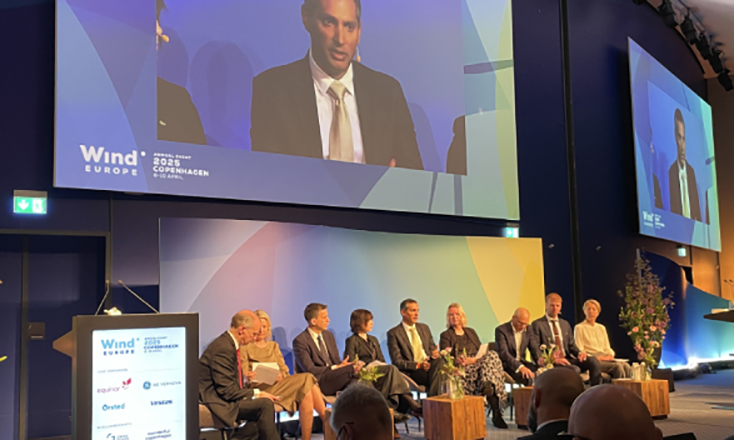
Industry leaders at WindEurope have stressed the importance of removing barriers to investment in wind energy to ensure that the technology can continue to play a pivotal role in energy security and affordability.
Speaking during the opening keynote session of the conference in Copenhagen, Orsted’s head of development in Europe, Duncan Clark, said: “Wind energy is challenged on so many fronts right now … and it is urgent that we remove some of those long-standing critical path constraints. We need to accelerate and we need to de-risk.”
Clark pointed to a need for well-structured contracts for difference contracts and auction systems as “really useful tools” for de-risking investments.
“A well-design CfD can reduce the cost of capital for these (large-scale) projects by two percentage points. That reduces the cost of electricity through their life by 15% or more,” Clark said.
“It seems to me that the last five years have been a test lab across Europe, testing out which frameworks, auction designs, remuneration mechanisms and project frameworks work.
“What we have learned is that those places that prioritise the realisation of projects and the derisking of investments have had the most success,” Clark added, citing the UK and Poland as examples of success.
He added that there is also a need to increase the rate of electrification to create demand for renewable energy, and reduce bottlenecks in the supply chain.
“Electrification is not happening fast enough and we need to work out the role of government and society,” he added, suggesting that carbon contracts for difference could play an important role in boosting demand for clean energy from energy intensive industries.
Meanwhile Javier Rodriguez Diez, Vestas executive vice president, said that governments and the industry still need to work on resolving permitting bottlenecks and grid investment.
“It is a waste of resources to have projects blocked in the system for years and years,” he told delegates.