


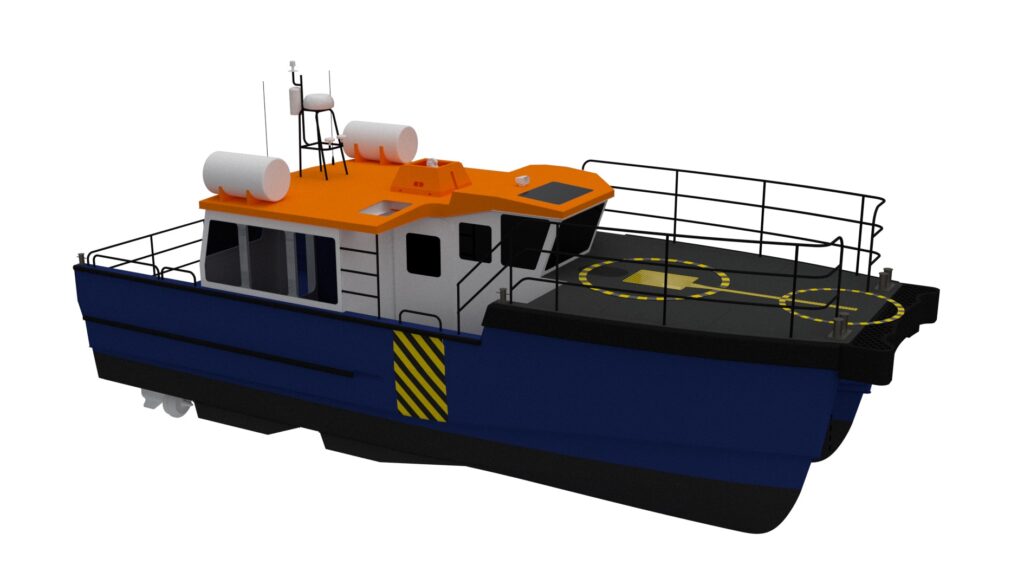
US offshore vessel operator Edison Chouest Offshore (ECO) has started construction of the US offshore wind industry’s first-ever mini-crew transfer vessel (CTV), designed by Chartwell Marine.
Set to begin operating in summer 2024 for Orsted and Eversource Energy, the CTV will simultaneously accompany the launch of ECO Edison, the first-ever American-built service operation vessel (SOV) announced in April this year.
This daughter craft onboard the SOV can be deployed to efficiently manoeuvre crew across the Revolution Wind, South Fork Wind, and Sunrise Wind offshore wind farms in the Northeast US, under development by Orsted and Eversource JV.
Building commenced in July 2023 at Edison Chouest’s Louisiana shipyard, drawing components from US suppliers, and using Chartwell’s design from its expanded range of offshore wind support catamarans – which has seen orders from across Europe, Asia, and the USA.
ECO will manage the entire pipeline of construction and operation, supported by the incentives provided by the Inflation Reduction Act.
Chartwell’s design responds to the increasing demand in the US offshore wind market for low-emissions, cost-effective support vessels, with the catamaran’s optimised hull form offering efficient fuel use as well as stability and manoeuvrability in choppy waters.
The Volvo Penta IPS (integrated propulsion system) provides high power and performance as well as onboard comfort for operators, ECO said.
The system allows for a wide number of optional features and functions, featuring forward-facing, twin counter-rotating propellers with an individually steerable IPS under the hull, it added.
The 12-metre mini-CTV has a capacity of up to 12 personnel and is designed to be deployed from ECO Edison during extended offshore stays, offering key staff comfortable and efficient access to turbines, vessels, and other critical project infrastructure.
Working closely with Orsted throughout the design process, Chartwell conducted model testing in January 2023 to simulate and adapt to the specifications of the wind turbines that will be installed at the north-east US project sites.
Considerations were made to facilitate Orsted’s Get Up Safe system, which is a motion-compensated hoist solution that enables technicians to safely transfer between small moving vessels and offshore wind turbines without a ladder.
Chartwell managing director Andy Page said: “This vessel is the small but essential chain connecting SOVs and turbines together. Engineers need to safely transition from larger vessels to turbines quickly and safely, and we set out to design an agile and streamlined vessel that has both bases covered.
“But it’s not a one-size-fits-all – turbines come in different configurations, with different requirements for effective crew transfer.
“That’s why we collaborated with Orsted to thoroughly test and tweak our design to the joint venture portfolio’s particular needs.
“We’re grateful for their collaboration and honoured to have our design be the first out on US waters servicing the renewables industry, and with Edison Chouest at the helm, no less.”
Vice president of renewables at ECO Michael Braid added: “ECO Edison needed to have the perfect partner on launch, and Chartwell has crafted her. As we look to further expand our fleet and activate it across a growing number of offshore wind projects, maintaining the efficiency of our transfers and our high level of technical availability will be key.
“Diversifying the range of vessels we use is one of the ways we can achieve that, but making sure they’re best-in-class is equally important.”