


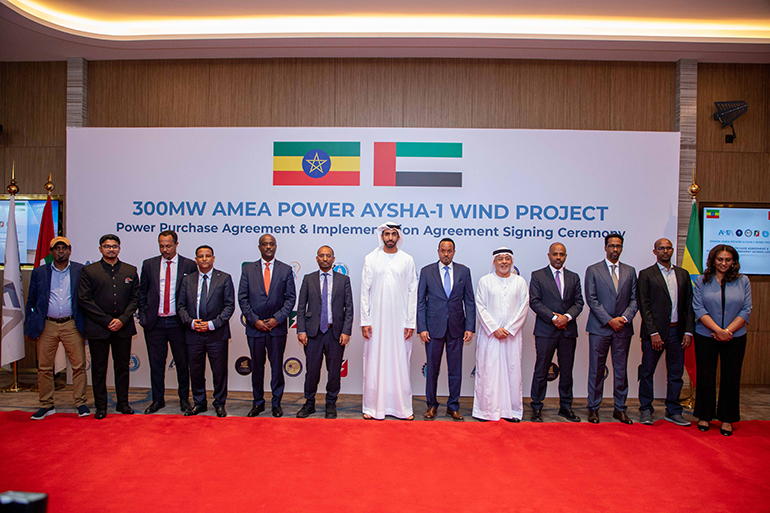
AMEA Power has announced the signing of a Power Purchase Agreement (PPA) and Implementation Agreement (IA) with Ethiopian Electric Power for the development and operation of a 300MW Aysha-1 wind energy project in Ethiopia.
The US$620m project in Aysha, Somali Region State, is expected to generate 1400GWh of clean energy annually, powering more than 4m households and reducing carbon emissions by more than 690,000 tons per year.
During the construction and operation phases, the scheme is expected to create more than 1500 direct jobs.
The signing ceremony was attended by Minister of Finance of Ethiopia Ahmed Shide, Minister of State for Foreign Affairs of the UAE Sheikh Shakhboot Bin Nahyan Al Nahyan, UAE Ambassador to Ethiopia Mohamed Salem Al-Rashedi, Ethiopian Electric Power chief executive Ashebir Balcha, head of PPP DG Ministry of Finance Abebe Gebrehiwot and AMEA Power Chairman Hussain Al Nowais.
“The 300MW Aysha-1 Wind Project marks a significant milestone for AMEA Power as we sign the Power Purchase Agreement and Implementation Agreement in Ethiopia,” said Al Nowais.
“This endeavour will be the largest wind farm in the Horn of Africa, setting a new benchmark for project-financed renewable energy in the country.
“This is more than just an energy project; it is a step towards a greener future for Ethiopia. We look forward to continuing our collaboration with our partners and stakeholder”.
The project was officially launched during COP28 in Dubai, where a Letter of Award was signed between the Ministry of Finance, Ethiopian Electric Power and AMEA Power. This followed AMEA Power’s qualification under the Public Private Partnership laws of Ethiopia.
During the ceremony, the PPA was signed with the Ethiopian Electric Power, the IA was inked with the Ministry of Finance of Ethiopia, and the Land Lease Agreement was signed with the Somali Region State Government.
AMEA Power said it will work closely with the local communities as part of its commitment to socio-economic development, and will undertake key social initiatives under its ‘Community Investment and Development Programs’, specifically addressing the core areas of education, water access among others.