


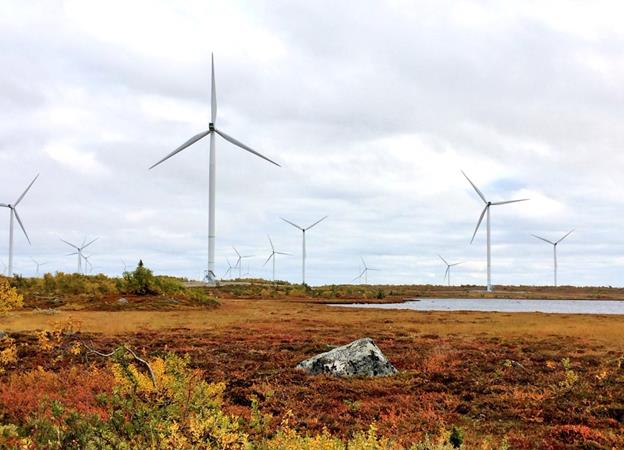
Municipal vetoes and the Armed Forces’ objections were the main reasons why only two new permits were granted for wind power on land and at sea in Sweden last year, new analysis has revealed.
The Swedish Wind Energy Association’s reports on settled permit cases for wind power in Sweden in 2024 paint a gloomy picture of the expansion of large-scale energy production in the country.
Of the 16 applications for onshore wind power projects that were finally decided in 2024, only one project was partially granted a permit. This compares with 12 granted permits in 2023.
For offshore wind power, 14 applications were finally decided last year, of which only one permit was granted.
Swedish Wind Energy industry lawyer Ina Müller Engelbrektson said: “It is extremely serious that so much new electricity production is stopped when the expansion needs to increase sharply.
“The government has the opportunity to quickly improve the conditions by changing the forms of the municipal veto and getting the promised incentives for municipalities, local residents and local communities in place.
“Furthermore, a clear mandate is needed for the Armed Forces to work for co-existence with wind power where possible.”
Interest in building wind power in Sweden remains high. For onshore wind, a record number of consultations was held in 2024 and the number of applications submitted was only slightly fewer than the year before.
For offshore wind power, planning is still underway in Swedish waters despite the 13 rejected applications in November last year.
Swedish Wind Energy’s head of offshore wind power Lina Kinning said: “The Inquiry into Offshore Wind Power has submitted a proposal that existing projects should continue to be managed according to the current process.
“There are 12 applications that are still waiting for the government to make a decision. The government now needs to grant the permits needed to enable the electricity production that Sweden needs for the transition.”
Westander Climate and Energy compiled permit statistics for onshore and offshore wind power on behalf of the Swedish Wind Energy Association.
The reports show how the granting of permits has looked in the years 2014 to 2024, including a breakdown by Sweden’s counties.
A striking example in the statistics is that only one project has received a permit for onshore wind power in southern Sweden (Bidding Area 4) in the last five years.
This is despite the fact it is the part of Sweden with the highest prices and where new electricity production is most needed.