


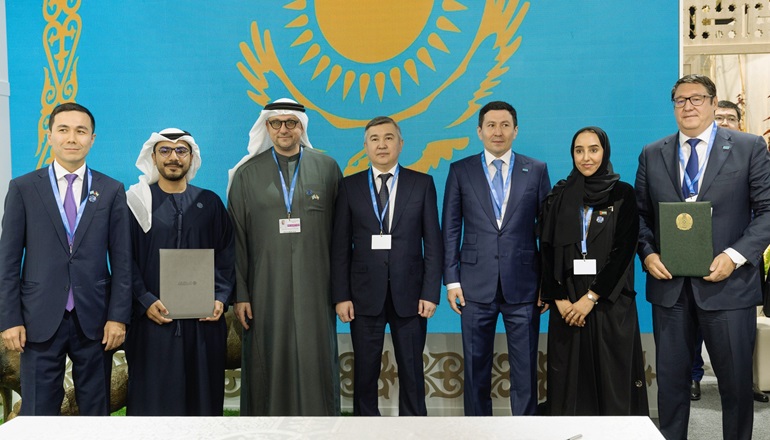
Masdar and its partners have reached a milestone in the development of their 1GW wind farm in Kazakhstan, with the signing of the project’s Investment Agreement.
Signed on the sidelines of COP29 in Baku, the deal was witnessed by Deputy Prime Minister – Minister of National Economy of the Republic of Kazakhstan Nurlan Baibazarov, chairman of the Board of Samruk-Kazyna Nurlan Zhakupov, and Masdar chief executive Mohamed Jameel Al Ramahi.
The agreement was signed by Kazakhstan Minister of Energy Almassadam Satkaliyev and Masdar director of business and project development Abdulla Zayed.
The wind farm is Masdar’s inaugural project in Kazakhstan, Central Asia’s largest economy.
It is located in the Jambyl region of the country and also features a 600-megawatt-hour (MWh) battery.
The 1GW wind project is being co-developed by W Solar, Qazaq Green Power (a Samruk-Kazyna Group company), and the Kazakhstan Investment Development Fund, with Masdar as the lead developer.
Construction of the wind farm is expected to commence by first quarter 2026.
UAE Minister of Energy and Infrastructure Suhail Mohamed Al Mazrouei said: “Today marks an important milestone for the UAE and Kazakhstan and highlights the strength of our strategic partnership.
“We are proud to support Kazakhstan’s net zero ambitions while in pursuit of implementing the key pillar of the historic UAE Consensus of tripling global renewable energy by 2030.”
Masdar chief executive Mohamed Jameel Al Ramahi said: “With Masdar’s proven success in implementing large-scale renewable energy projects worldwide, we are confident that this 1GW wind farm will have demonstratively positive impact in its surrounding region.
“In our ongoing collaboration with the government of Kazakhstan, as well as our valued partners at W Solar, Qazaq Green Power and the Kazakhstan Investment Development Fund we’re excited to see the continued growth of this project and the benefits it will bring to the region.”
The wind farm in the Jambyl region will help accelerate Kazakhstan’s energy transition, supporting the country’s ambitions to increase renewables capacity to 15% of its energy supply by 2030 (and to 50% by 2050) and achieve carbon neutrality by 2060.