


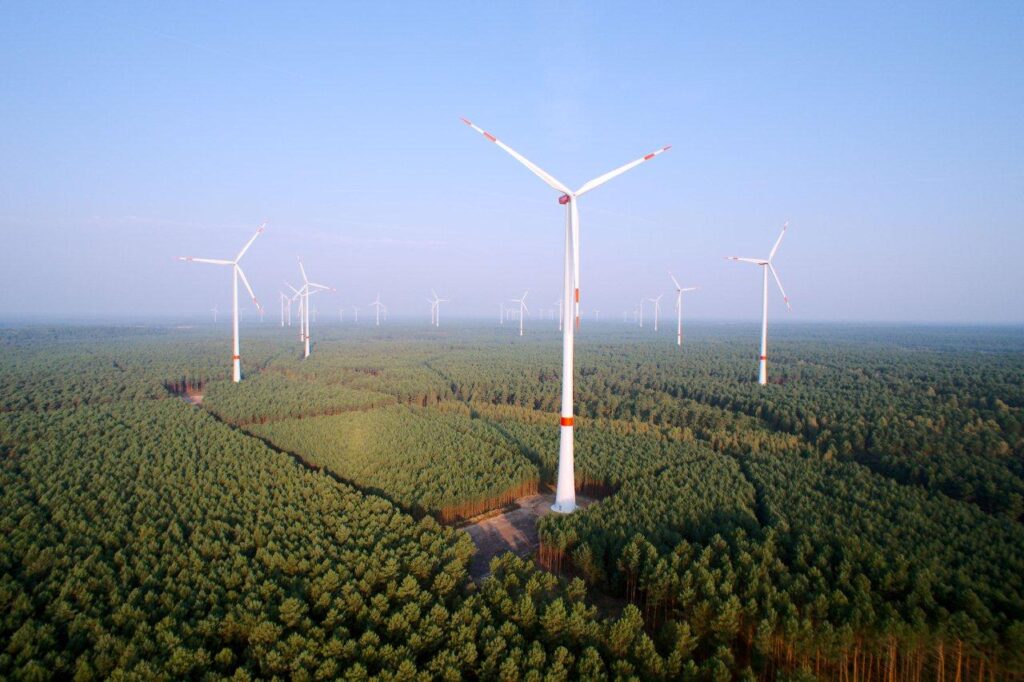
Germany’s community-owned wind farm sector is finding it more challenging to develop projects successfully as a result of Berlin’s switch to capacity auctions, according to the findings of a new study.
The study, undertaken by the World Wind Energy Association (WWEA) and the Renewable Energy Association of North Rhine-Westphalia (LEE NRW), investigated the effects of switching from fixed feed-in tariffs to auctions on wind plants owned and controlled by local groups, between 2017 and 2019.
The interviewed participants in the study rated the auction system negatively, for providing additional risk and increased complexity in the development phase.
Many participants said they would prefer a return to the previous feed-in tariff system, which was viewed as non-discriminatory, compared with the auction system.
Respondents also cited licensing regulations, particularly in relation to air traffic control, military airspace use and nature conservation, as problematic, preventing further growth of onshore wind in Germany.
WWEA secretary general Stefan Gsanger said: “The German Government has missed all three goals, which it has linked with the introduction of auctions.
“It has not reached its installation targets, nor have the auctions achieved cost-effective results, and the diversity of players has suffered since the beginning of 2017, calling into question the acceptance of wind energy and the energy transition as a whole.
“Germany was once a global role model for the introduction of renewable energy, not only in technological terms but also through the high level of involvement among citizens, which has been lost since the introduction of auctions.”
According to the study, wind energy policy by the North Rhine-Westphalia state government has been poorly received, mainly due to onerous planning regulations.
The new development plan (LEP), introduced by the state, in principle, provides for a minimum distance of 1500 metres for new wind farms in relation to residential areas, and places regulation of wind energy under regional planning.
LEE NRW director Jan Dobertin said: “In addition to distortions caused by the auctions and considerable barriers under licensing law, the state government’s new planning law requirements are creating problems for community wind.
“In the future, hardly any land will be available for community wind projects.”
The study has produced recommendations for federal and state governments:
A commitment to the full transition to renewable energy with wind energy as a cornerstone and as a fundamental part of an effective climate change mitigation strategy.
A commitment to the importance of community-owned energy and its many advantages, as well as to the creation of framework conditions conducive to the further development of community-owned energy.
Inclusion of the priority for renewable energies in a national climate protection law or in constitutional law at state and federal level.
Creation of a non-discriminatory remuneration system beyond auctions, in accordance with the decisions by the European Court of Justice.
Prompt and rapid reduction of bureaucratic barriers and hurdles under planning law such as general minimum distances.
Strengthening local energy concepts and promoting local and regional approaches to sectoral coupling.
Promotion and further development of prosumer models as decided at European level.
Promote cooperation of community energy players and developers, at regional, national and cross-border level.