


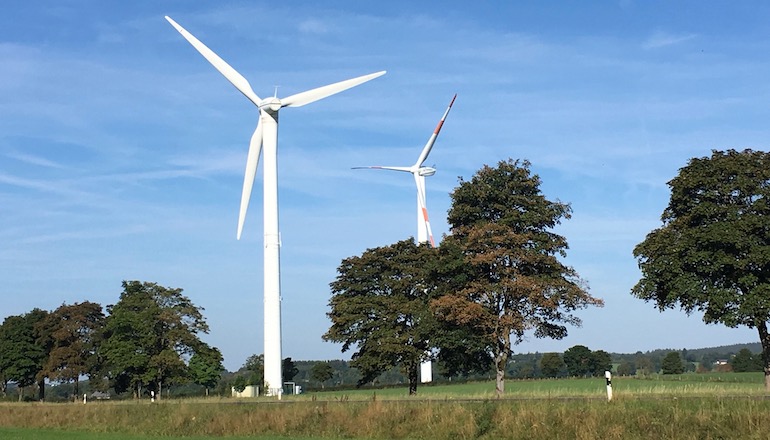
Germany added onshore wind turbines with total capacity of 1078MW in 2019, falling 55% from 2018 to the lowest level for 20 years, according to a new report published by Deutsche Windguard.
Taking into account 82 machines with a combined capacity of 97MW that were dismantled the net addition in 2019 was 981MW from 243 turbines, said the report which was carried out for Deutsche Windguard by VDMA Power Systems and Bundesverband WindEnergie (BWE).
In total, at the end of December 29,456 turbines were installed in the country with capacity of 53,912MW.
The report said that the average turbine size was 3.3MW, up 3% on 2018, with hub heights and rotor diameters also increasing on average from the previous year to 119 metres and 133 metres, respectively. The average tip height in 2019 was 193 metres.
The largest share of new capacity was in the region of Brandenburg (22%), with Lower Saxony and North Rhine-Westphalia in second and third place.
Only Mecklenburg-Western Pomerania and Rhineland- Palatinate of the other German regions were also able to achieve additions beyond 100MW.
A total of 3675MW of onshore capacity was tendered in 2019 but only 1847MW was awarded, the report said.
The low level of competition is also reflected in price, which over the course of 2019 approached the maximum permissible value of €62 a megawatt-hour, it added.
Electricity generated by onshore wind in Germany was 106 terrawatt-hours in 2019, up 13% on 2018.
Project permit awards, a prerequisite for participation in the coming tender rounds, were about 2GW last year, up 29% on 2018.
However, the figure is much lower than before the introduction of the tender system in Germany, the report said.
A total of 4.1GW is expected to be offered in auctions in 2020 and so the total number of permits registered and not yet awarded (about 2.1GW) is still not sufficient to meet the tender targets for 2020, BWE and VDMA said.
They said that an increase of about 5GW a year is needed to meet the country’s 65% renewable energy target for 2030.
BWE and VDMA Power Systems called on the state and federal governments to refrain from the distance regulation for onshore turbines.
VDMA Power Systems managing director Matthias Zelinger said: “The effects of the expansion lull on employment and value creation in the wind industry must now be urgently overcome in order to maintain the substance in Germany.
“The wind industry has already had to react to the declining production for the domestic market with drastic reductions in employment.
“If the market stagnates at this level, the loss of demand from Germany alone threatens to take away another 25% of the workforce.”
BWE president Hermann Albers said: “In order to fill the tender volumes with projects and to achieve the expansion and climate protection targets, the identified and long known approval obstacles must be removed as quickly as possible and more areas must be declared for wind turbines.
“This requires an agreement between the federal government and the Lander before the end of spring.
“New hurdles such as general distance regulations would aggravate the situation and lead to a loss of about 40% of the potential wind areas in Germany.”